

A document can be translated accurately and still be rejected if the provider’s credentials or the translation format do not meet the receiving authority’s requirements. In the UAE, choosing accredited translation services means checking more than language ability. For legal documents intended for official use, the translator’s Ministry of Justice accreditation may be essential.
If you are unsure whether your document needs a certified legal translation, a general professional translation, or additional steps such as attestation, you are not alone. These terms are often used loosely, but they are not interchangeable. The right option depends on where and how you will submit the document.
This guide explains what accreditation means for translation in the UAE and how to verify a provider’s credentials, language pair, relevant experience, and document-handling procedures. You will also learn what to confirm about the required format and any separate attestation before proceeding. The aim is to help you match verifiable credentials to your document’s intended use and reduce avoidable delays. ConnectIn Business Services offers certified legal translation, document attestation, and PRO support for business-related administrative needs. Always confirm the specific requirements for your document before submission.
Key Takeaways
- Match the translation type to the document’s purpose. Certified legal translation and general professional translation are not interchangeable.
- When comparing accredited translation services, ask for the credential or approval relevant to your document and language pair.
- Identify the receiving authority first, then confirm its required translation format before placing an order.
- Prepare clear source files and confirm whether originals, certified copies, or specific file formats are needed.
- For business documents, consider how translation, attestation, and PRO support may fit into the process, while treating each as a distinct service.
What Do Accredited Translation Services Mean in the UAE?
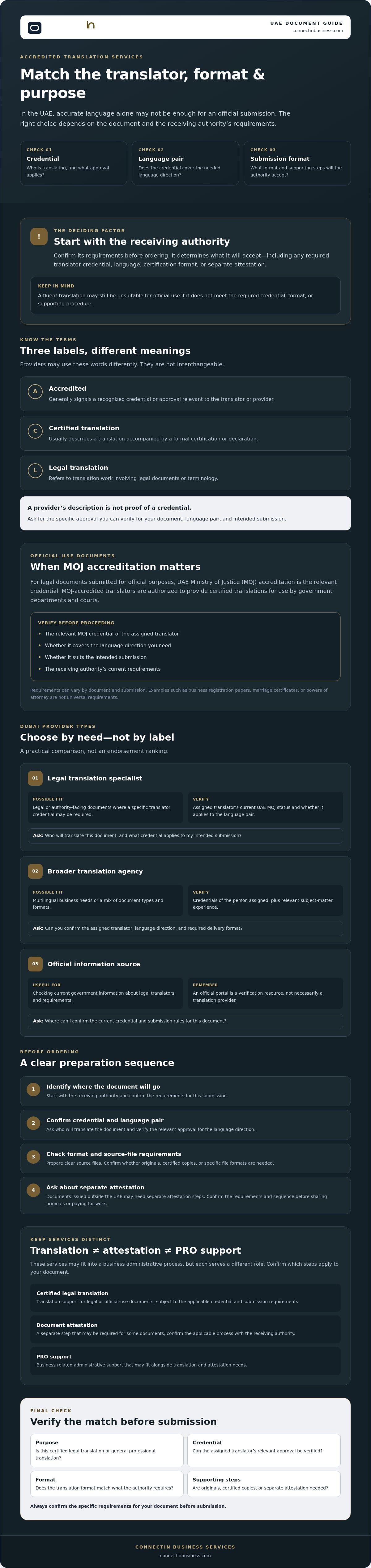
In the UAE, “accredited” should refer to an approval or credential relevant to the translator, document, and intended use. For legal documents submitted for official purposes, UAE Ministry of Justice (MOJ) accreditation is the relevant credential: only MOJ-accredited translators are authorized to provide certified translations for use by government departments and courts. However, this does not mean every document or submission follows the same process. The receiving authority’s requirements remain decisive.
Terminology can be confusing because providers may use “accredited,” “certified,” and “legal” differently in their descriptions. The global overview of certified translation also explains that requirements vary by country. A fluent translation may still be unsuitable for an official submission if it lacks the required credential, format, or supporting procedure.
Accredited, certified, and legal translation: what is the difference?
Accredited generally signals that a translator or provider has a recognized credential or approval. Certified translation usually describes a translation accompanied by a formal certification or declaration, while legal translation refers to work involving legal documents or terminology. These labels are not interchangeable, and their precise meanings can vary by provider and jurisdiction.
A provider’s marketing description is not proof of a credential. Ask for the specific approval you can verify for your document and language pair. Where applicable, request the translator’s relevant MOJ credential and confirm that it covers the language direction and intended submission.
When might a UAE document need a legally recognized translation?
A corporate document, personal-status record, or administrative document may need a legally recognized translation if it is being submitted to a government department, court, or another authority. Examples can include business registration papers, marriage certificates, or powers of attorney, but these are possibilities, not universal requirements. The receiving authority determines what it will accept.
Before ordering, ask the receiving authority whether it requires a particular translator credential, an Arabic translation, a specific certification format, or additional attestation. Documents issued outside the UAE may need separate attestation steps. Translation and attestation serve different purposes, so confirm the sequence and requirements before sharing originals or paying for work. ConnectIn Business Services lists certified legal translation, document attestation, and PRO services. Verify the applicable translator credentials, language pair, and format for your submission.
A Practical Roundup of Translation Provider Types in Dubai
In Dubai, you can arrange translation through different types of providers, but the right option depends on the document and where it will be submitted. Use the comparison below to decide whom to approach and what to verify. It is a guide to provider types, not an endorsement ranking.
| Provider type | Suitable use case | Credential check | Question to ask |
|---|---|---|---|
| Legal translation specialist | Legal or authority-facing documents where a specific translator credential may be required. | Check the assigned translator’s current UAE Ministry of Justice (MOJ) status and whether it applies to the language pair. | “Who will translate this document, and what credential applies to my intended submission?” |
| Broader translation agency | Multilingual business needs or a mix of document types and formats. | Verify the credentials of the person assigned to the document, not only the agency’s general claims. Ask about relevant subject-matter experience. | “Can you confirm the assigned translator, language direction, and required delivery format?” |
| Official information source | Checking current government information about legal translators and requirements. | Consult MOJ guidance and its current legal-translator information. An official portal is a verification resource, not necessarily a translation provider. | “Where can I confirm the current credential and submission rules for this document?” |
Legal translation specialists and broader translation agencies
A specialist may suit a document intended for a court, government department, or another authority that specifies a legal translator credential. An agency may be useful for a business handling multiple languages or varied materials, but a broad service catalogue does not establish that every translator is qualified for every task. Ask who will handle your file, then verify that person’s credentials for the relevant language pair and intended use.
Government sources and credential-checking routes
The UAE Ministry of Justice is the official source to consult for current information about legal translators. Check its latest guidance, then confirm the receiving authority’s requirements directly. The required format or procedure may differ by document and submission. International quality frameworks, including ISO 17100:2015, may describe translation-service processes, but they do not replace UAE-specific approval or prove that an authority will accept a translation.
For business-related requirements, ConnectIn Business Services lists certified legal translation, document attestation, and PRO support as distinct services. You can review its business translation and administrative support and confirm the relevant translator credentials, language coverage, and format for your document.
How to Compare and Verify Accredited Translation Services
Use the same checks for each provider before making a decision. A polished website or broad service list can help you identify potential options, but neither confirms that the assigned translator meets your document’s requirements. Assess the credential, deliverable, and document-handling process together.
The relevant credential depends on the receiving authority and the document’s purpose. The same translator or translation format may not suit every submission.
- Identify the receiving authority. Ask the department, court, or other recipient which translation requirements apply, including any specified credential or format.
- Define the document and language direction. Tell the provider what the document is, where it will be used, and whether the translation is from or into Arabic. Mention specialist terminology and any supporting pages.
- Verify the assigned translator’s credentials. Request the exact credential or approval relevant to the document and language pair. For legal-translator information, consult the UAE Ministry of Justice certified translators resource and confirm the current status.
- Confirm the required format. Establish whether the authority expects certification, stamps, a digital file, physical copies, or another specified format. Clarify whether the provider’s scope includes each item.
- Agree the delivery terms in writing. Confirm the expected turnaround, delivery method, revision process, confidentiality arrangements, and any exclusions before sending documents or approving the work.
Questions to ask before you appoint a translator
Ask who will translate the file and whether that person’s current credentials apply to your document and language pair. Confirm precisely what you will receive, including certification, stamps, electronic files, or physical copies if required. Request a written scope covering delivery expectations, revision terms, confidentiality, and exclusions. These details give you a clear basis for comparing proposals and addressing misunderstandings before work begins.
How to spot unsupported or overbroad claims
Treat claims of guaranteed acceptance cautiously unless the receiving authority confirms that the stated requirement is sufficient. Check credential details, including the issuing body and current validity, rather than relying on badges or general wording. Keep services distinct: translation does not automatically include attestation, notarisation, or legal representation. Ask separately about any additional procedure required by the authority.
What to Prepare Before Ordering an Official Translation
A complete request helps a provider assess the appropriate language expertise, credential, format, and scope before work begins. Before contacting accredited translation services, gather the details below and confirm submission rules with the authority receiving your document.
Documents and instructions to gather
- Clear, complete source files: Prepare legible scans of every page, including reverse sides when they contain information. Preserve the original page order and make sure names, dates, signatures, seals, and stamps can be read.
- Language direction: State the source and target languages, such as English to Arabic, and identify any pages already in another language.
- Purpose and destination: Explain what the document is for and name the receiving authority or organisation. A company document for an administrative submission may have different requirements from a personal record intended for another process.
- Deadline and delivery needs: Give your required date and ask what turnaround can be agreed. Confirm whether you need a digital file, physical copies, or both.
- Originals and file requirements: Before sending or handing over documents, check whether the recipient requires an original, a certified copy, or a specific file format. Do not assume a scan will be sufficient.
To assess a translation request accurately, a provider needs a legible, complete document, the language direction, the intended use and receiving authority, and the required format and deadline.
Translation, attestation, and submission are separate checks
Translation changes the document’s language. It does not automatically complete attestation or authentication. These are separate processes and may involve different authorities or requirements. An authority may specify a sequence, supporting documents, or format, so ask what applies before arranging each step.
For example, a company document may need translation for a submission and may also require attestation. The exact requirements depend on the document and receiving authority. Confirm current guidance directly rather than treating a general checklist as a definitive UAE procedure.
Before sharing sensitive business or personal records, ask how files will be handled, who can access them, how they will be transferred, and whether copies are retained. Confirm the written scope too, including exclusions or revision terms, so you know what the service covers.
ConnectIn Business Services lists certified legal translation, document attestation, and PRO services as distinct forms of support for UAE business administration. Discuss your business translation and document support needs, and confirm the applicable language pair, credentials, and required format before proceeding.
Choosing Translation Support for a Dubai Business: A Clear Next Step
For a business document, follow a straightforward decision path: identify why the document is needed, confirm the receiving authority’s requirements, verify the relevant provider credentials, and clarify the format and scope before submitting it. This helps you select accredited translation services based on the document’s actual use rather than a broad claim about a provider.
When business translation may need administrative support
Corporate records used for a company transaction or administrative filing may need translation, attestation, or both, depending on the document and authority involved. These are separate requirements: translation addresses language, while attestation is a distinct document process. PRO support is a separate service and does not replace either one.
Before proceeding, confirm with the relevant authority which steps apply, what order they should follow, and what format it expects. Requirements can differ by document and purpose, so do not treat one business’s process as a rule for every submission.
How ConnectIn Business Services can help with a UAE enquiry
ConnectIn Business Services supports UAE businesses with certified legal translation, document attestation, and PRO services. These offerings may be relevant at different stages of a business-document workflow, but they are not interchangeable. For a translation enquiry, confirm whether the assigned translator’s credentials, language pair, and proposed format match the receiving authority’s requirements. Do not assume a provider has the right approval for every document without checking.
To make an initial discussion more useful, share the document type, source and target languages, and intended use. You can also state which authority will receive it and any format or timing requirements you have been given. Avoid sending originals or sensitive files until you have confirmed what is required and how documents will be handled.
If your business needs to clarify its options, contact ConnectIn about business translation support with those details. Confirm the applicable credentials and acceptance requirements before submitting the completed translation.
Make Your Next Translation Decision with Confidence
The right provider is the one whose credentials and deliverables match your document’s intended use. Before ordering accredited translation services, confirm requirements with the receiving authority, verify the assigned translator’s relevant approval and language pair, and agree on the required format and delivery scope.
Keep translation, attestation, and PRO support distinct. A business document may involve more than one of these services, but the authority determines what applies and in what sequence. Confirm those requirements before submitting documents or arranging additional steps.
ConnectIn Business Services lists certified legal translation alongside document attestation and PRO support for UAE businesses. These may be relevant options for different parts of a business-document workflow. Share the document type, language pair, and intended use when you discuss your business translation requirements with ConnectIn, and confirm the applicable credentials and format for your submission.
A clear brief and verified requirements give you a stronger starting point. With the right checks in place, you can move forward with greater confidence.
Frequently Asked Questions
What does “accredited translation services” mean in the UAE?
It means the provider’s relevant approval or credential should match the translator, document, and intended use. In the UAE, translation is regulated, and legal documents for official use may require a translator accredited by the Ministry of Justice (MOJ). The word “accredited” in a service description alone does not establish that the assigned translator holds the credential your submission requires. Confirm the requirement with the receiving authority and verify the applicable credential.
How can I check whether a legal translator is approved in the UAE?
Check current information through the UAE Ministry of Justice and ask the provider for the assigned translator’s specific credential or licence. Confirm that it applies to the document and language pair you need, and check the details against the official source rather than relying only on a website badge or general claim. Then confirm the receiving authority’s requirements. Verifying a credential does not establish every submission detail or guarantee acceptance.
Is certified translation the same as legal translation in Dubai?
No. The terms describe different aspects of translation and should not be treated as interchangeable. “Legal translation” can refer to translating legal material, while “certified translation” usually describes a translation accompanied by a formal certification or declaration. Usage varies between providers and jurisdictions. For a Dubai submission, ask what certification is included and whether the assigned translator has the specific approval required for your document and intended use.
Do translated documents also need attestation in the UAE?
Sometimes, but translation and attestation are separate processes, and one does not automatically complete the other. Whether attestation is required depends on the document, its origin, and the receiving authority’s instructions. Before ordering, ask the authority what steps apply, in what sequence, and whether it requires an original, certified copy, or particular format. Do not assume a general process applies to every UAE submission. Confirm current requirements for your case.
Can I use an overseas or online translation agency for UAE documents?
Possibly, but the agency’s location or online workflow does not determine whether its translation will meet UAE submission requirements. Before sending files, check with the receiving authority and ask who will translate the document, what credentials apply to that person and language pair, and whether the final format is acceptable. If legal-translator approval is required, verify it through the relevant UAE source. Also confirm secure document handling before sharing sensitive records.
What should I send when requesting a translation quote?
Provide a clear, complete copy of the document and state the source and target languages, intended use, receiving authority, and requested delivery date. Mention whether you have been told to provide an original, certified copy, electronic file, or physical copy. Include all pages and ensure names, dates, seals, and signatures are legible. Ask the provider to confirm the assigned translator’s relevant credentials, written scope, delivery expectations, confidentiality, and any exclusions.
Does a certified translation guarantee acceptance by every UAE authority?
No. A certified translation does not guarantee acceptance by every authority because requirements can vary according to the document, purpose, language pair, and submission procedure. Confirm the required credential, format, and any separate attestation steps with the organisation receiving the document before ordering. Ask the provider to explain what its certification includes, but treat the authority’s current instructions as decisive. This check can help reduce avoidable problems, though it cannot promise an outcome.


