

Dubai is open to foreign founders, but the right setup depends on what you plan to do and where you need to operate. In most sectors, foreigners can own 100% of a company. This guide explains how to start a small business in Dubai for a foreigner, from selecting a business activity and jurisdiction to arranging premises and a trade licence.
Starting a small business in Dubai as a foreigner means choosing a compliant structure as well as a workable budget. Costs depend on the licence, jurisdiction, premises, visas and ongoing obligations, so plan beyond the licence fee. The steps below explain how to compare mainland and free zone options, prepare for approvals, and account for setup and recurring expenses before choosing a structure.
Key Takeaways
- Start by matching your business activity to the right licence and identifying any additional approvals it may require.
- Compare mainland and free zone jurisdictions against your intended customers, operating needs and ownership structure before choosing where to register.
- Factor premises into your plan early: office requirements and location can affect both compliance and the number of visas available.
- Budget beyond the initial licence by accounting for setup costs, annual renewals and ongoing operating expenses.
- Use a clear setup plan to decide when Mainland Company Formation or Free Zone Company Formation support is relevant to your chosen structure.
Business activity, trade name, and initial approval
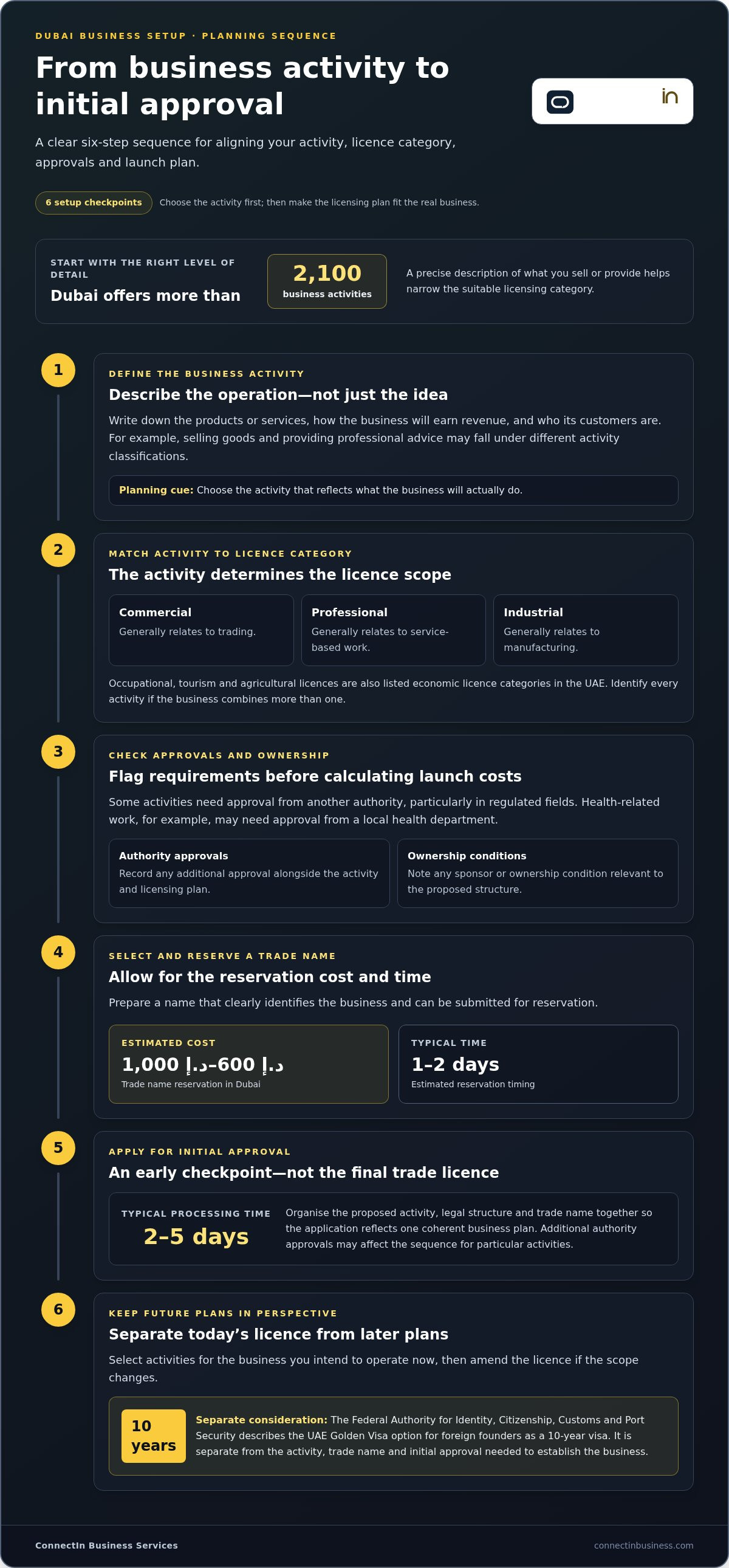
In Dubai, the licence category depends on the business activity. Commercial, professional and industrial licences cover common activity groups; other listed categories include occupational, tourism and agricultural licences.
- Define the activity before selecting a licence. Write down the products or services you will provide, how you will earn revenue, and who your customers are. Dubai offers more than 2,100 business activities, so a precise description helps narrow the suitable licensing category. For example, selling goods and providing professional advice may fall under different activity classifications. Choose the activity that reflects the actual operation, not only the broad business idea.
- Match the activity to the licensing category. Commercial licences generally relate to trading, professional licences to service-based work, and industrial licences to manufacturing. Occupational, tourism and agricultural licences are also listed economic licence categories in the UAE. If your business combines activities, identify each one before applying. The activities determine the licence scope, and some may require additional approval from relevant authorities.
- Identify approvals and ownership considerations early. An activity may require approval from another authority, particularly in a regulated field. Health-related work, for example, may need approval from a local health department. Record each requirement alongside your activity and licensing plan. Note any sponsor or ownership condition relevant to your proposed structure before calculating the investment needed to launch.
- Choose a trade name that fits the planned activity. Prepare a name that clearly identifies the business and can be submitted for reservation. Trade name reservation in Dubai is estimated to cost د.إ 600 to د.إ 1,000 and typically takes 1 to 2 days. Include that expense and timing in your launch plan, alongside preparation of the activity details and application documents.
- Apply for initial approval before proceeding with setup. Initial approval for a Dubai business typically takes 2 to 5 days. Treat it as an early step in the process, not as the final trade licence. Organise the proposed activity, legal structure and trade name together so the application reflects one coherent business plan. Additional authority approvals may affect the sequence for particular activities.
- Keep future plans separate from the current licence decision. Select activities that support the business you intend to operate now, then amend the licence if the scope changes. The Federal Authority for Identity, Citizenship, Customs and Port Security describes the UAE Golden Visa option for foreign founders as a 10-year visa. Consider that visa separately from the activity, trade name and initial approval needed to establish the business.
Mainland, free zone, and offshore jurisdictions
Yes. Foreigners can own 100% of companies in most UAE sectors, including many mainland activities. Some activities have ownership conditions, so determine the rules for your specific activity before choosing a structure.
- Map your customers and operations. List where your customers are, where you will deliver services, and whether you need to trade directly in the UAE market. These details help determine whether mainland or free zone registration suits your business. For example, a company serving local customers may weigh mainland access differently from an exporter focused on international markets.
- Compare mainland structures against your activity. UAE mainland businesses can use structures such as a sole establishment, civil company, limited liability company, holding company, or public or private joint stock company. Branch and representative-office structures are also listed options. The appropriate legal form depends on the proposed activity and ownership arrangement. Some mainland activities may require a UAE citizen partner or local stakeholder.
- Assess free zone options by operating requirements. Dubai has over 30 free zones, while the UAE has more than 40. Each free zone has its own authority and registration process. Free-zone legal forms include a Free Zone Limited Liability Company, Free Zone Company, and Free Zone Establishment. Compare the permitted activity, premises, visa needs, and customer profile before selecting a free zone.
- Check ownership conditions before submitting initial approval. Foreign ownership is available in most sectors, but some strategically important mainland businesses require a local stakeholder to own 51% or more. Certain activities may also require a local agent. Treat these as activity-specific considerations, not assumptions that apply to every mainland company. Confirm the intended ownership structure aligns with the chosen licence activity.
- Consider offshore registration only for a defined business purpose. Compare its suitability with mainland and free zone structures by reviewing where the company will operate, whom it will serve, and what presence it needs. An offshore label alone does not determine whether the structure fits your plans. Set out the intended activity and commercial relationships first, then assess the relevant jurisdiction’s requirements.
- Make a side-by-side decision before incorporation. Record the activity, ownership, customer location, office needs, and future expansion plans for each option. This comparison makes trade-offs visible before you commit to a jurisdiction. If mainland or free zone formation is the next step, explore mainland and free zone company formation support for structuring the setup.
Business premises and location requirements
For mainland businesses, VAT is 5%, according to the UAE Federal Tax Authority. The UAE corporate tax rate is 9% on taxable profits exceeding د.إ 375,000. Keep organised records of income, expenses, invoices and business transactions to support accurate accounts and tax reporting.
- Choose premises that match your licence and operations. Businesses operating in the UAE must have a physical address. Consider whether your work needs a private office, warehouse or flexible workspace. For example, a consultancy may have different space needs from a business storing goods. Dubai office costs are estimated at د.إ 15,000 to د.إ 50,000 or more annually.
- Check the space requirement for your jurisdiction. Dubai mainland companies must lease an office of at least 200 square feet, and virtual offices are not allowed. A private office is listed at د.إ 20,000 to د.إ 50,000 per year. A flexi-desk is listed at د.إ 5,000 to د.إ 10,000 per year, but it may not meet every activity’s requirements.
- Register the tenancy contract where required. In Dubai, office or warehouse tenancy contracts must be registered through the Dubai Land Department’s Ejari portal. Keep the contract and premises details with your company documents. Some premises need a valid tenancy contract to meet the relevant authority’s requirements, so align the lease with the licence application.
- Prepare shareholder and manager documents. Free zone applications commonly require passport copies for shareholders and the appointed manager. Arrange clear copies and keep each person’s details consistent across application documents. If the company has several shareholders, organise their documents before submission to avoid delays from incomplete records or inconsistent information.
- Plan residency steps after the trade licence. A business owner can apply for partner or investor visas and employee visas after obtaining a trade licence. Foreign founders should plan 3 to 5 working days in the UAE for medical fitness testing, biometrics and Emirates ID steps. Include these visits in your setup schedule alongside office and licence arrangements.
- Build recordkeeping into routine operations. Retain contracts, invoices, expense records and evidence of business transactions in an orderly system. Annual accounting and audit fees for a small Dubai business are listed at د.إ 5,000 to د.إ 15,000. Clear records help prepare financial information and support your tax reporting as the business grows.
Commercial, professional, and industrial licences
Choose a licence by matching your business activity to its category, application requirements and operating structure. Dubai’s trade licence process also depends on whether the activity needs additional authority approvals.
A straightforward UAE company setup takes 7 to 14 working days from initial approval to trade licence. Regulated sectors may take 4 to 8 weeks; remote submission does not remove physical document or authority requirements.
-
Identify the Licence Category
Classify your activity as commercial, professional or industrial before preparing the application. Commercial licences generally cover trading, professional licences cover services, and industrial licences relate to manufacturing. Your business structure, ownership and planned operations should align with the activity listed on the licence. Avoid choosing a broad category that does not describe what the company will do, since a mismatch can affect approvals and permitted operations.
For example, a business selling products and a consultancy providing advice may need different activity classifications. List each planned activity and identify which one will drive the company’s main operations. This gives the licensing application a clear basis and helps identify additional approval requirements early.
-
Obtain Initial Approvals and Licensing Documents
Prepare the licensing application around the chosen activity, legal structure and proposed ownership. Submit the initial approval application before proceeding with the remaining setup steps. Keep details consistent across forms and supporting documents, including shareholder and manager information where applicable. Inconsistent names or activity descriptions can slow review and require corrections.
Create a document checklist before submission. Include the identification and company details required for the selected structure, plus premises or other supporting records relevant to the activity. Some activities require additional approval from relevant authorities. Identify those requirements before finalising the application sequence, particularly for regulated work where approvals can extend the licensing timeline.
-
Pay Fees and Obtain the Licence
Budget for the licence and related setup charges before submitting the final application. A trade licence for a lean Dubai small-business setup is estimated at د.إ 10,000 to د.إ 15,000. The final cost depends on the activity, business structure and associated approvals. Treat this range as a planning estimate, not as a quoted price for a particular company’s services.
After approvals and required documents are in place, complete the applicable payment and licence issuance steps. Issuing a Dubai business licence typically takes 3 to 10 days. Regulated sectors may take longer, with trade licensing estimated at 4 to 8 weeks. Review the issued licence carefully to ensure its activities match the operations you intend to conduct.
Company setup costs and recurring expenses
Build your budget around the jurisdiction, licence, premises, visas and ongoing operations. The figures below are planning estimates in AED, not prices for formation services.
- Set a realistic first-year budget. A Dubai mainland setup is estimated at د.إ 35,000 to د.إ 60,000 at 2026 rates. A UAE free zone setup, including a licence, flexi-desk and one investor visa, is estimated at د.إ 15,000 to د.إ 35,000 at 2026 rates. The totals vary with activity, office needs and visa requirements.
- Compare free zone options carefully. Premium free zones such as DMCC and DIFC have setup costs starting near د.إ 45,000. A lean free zone business setup may require a starting budget around د.إ 25,000. Compare what the package includes, including workspace and visa allocation, before deciding whether the lower initial outlay supports your intended trading and operations.
- Separate licence expenses from other charges. Dubai trade licences typically cost د.إ 10,000 to د.إ 30,000. Initial approval is estimated at د.إ 1,000 to د.إ 3,000, while miscellaneous approvals are estimated at د.إ 2,000 to د.إ 5,000. Build these lines into the budget alongside premises, rather than treating the licence as the complete establishment cost.
- Forecast recurring annual expenses. Ongoing annual business costs in the UAE are estimated at 60% to 80% of first-year cost. Annual maintenance for a small Dubai business is estimated at د.إ 25,000 to د.إ 70,000 per year. Licence renewal, accounting, audit, workspace and visa-related expenses can all affect the total. Keep these commitments visible in your operating forecast.
- Reserve cash for accounting and operating needs. Annual accounting and audit fees for a small Dubai business are listed at د.إ 5,000 to د.إ 15,000 annual. Plan at least six months of operational funds for rent, payroll, suppliers and routine government obligations. A trading company may also need working capital for stock and payment cycles, while a service firm may prioritise staff costs.
- Include banking in your launch schedule. Corporate bank account approval is estimated at 2 to 4 weeks for a resident founder and 8 to 12 weeks for a non-resident founder. Digital bank account approval is estimated at 3 to 7 working days. Keep incorporation documents and business activity details consistent across applications, and account for banking timelines separately from licence issuance.
- Choose a setup path that fits the budget. Compare mainland and free zone structures against your activity, location needs and expected costs before committing. If you are ready to establish the company, plan your mainland or free zone company formation with support aligned to your chosen structure.
ConnectIn Business Services: Mainland Company Formation
ConnectIn Business Services helps foreign founders choose and establish a suitable UAE company structure. Turn to the firm when your activity, jurisdiction and ownership plans are clear and you need support progressing with formation.
For a mainland setup, Mainland Company Formation supports the steps involved in establishing the company. If your plans point to a free zone, Free Zone Company Formation is also available. Existing businesses can use Trade License Amendments to change licensed activities or company details, and Share Transfer Services to transfer ownership interests.
These services support different stages of a company’s lifecycle, from initial formation to later structural changes. To discuss the next step for your setup, contact ConnectIn Business Services.
Turn Your Plan Into a Practical Next Step
Once you understand how to start a small business in Dubai as a foreigner, turn the plan into a sequence of decisions. Confirm the intended activity, agree on the ownership structure, and set operational priorities for launch. A written plan keeps registration choices aligned with the business you intend to build, rather than treating setup as a stack of separate forms. It also gives founders and shareholders a shared reference as responsibilities and company details take shape.
Before moving ahead, record the company’s intended scope, who will hold shares, and which operational decisions need to be settled first. This gives formation discussions a practical focus. ConnectIn Business Services offers Mainland Company Formation and Free Zone Company Formation for founders moving from planning to establishment. If company needs change later, Trade License Amendments can support updates to licensed activities or company details.
The appropriate route depends on the structure you have selected and the changes required. Contact ConnectIn Business Services today to discuss the formation route or licence amendment relevant to your next step. With a defined plan and a suitable structure, you can move forward with clarity and focus.
Frequently Asked Questions
Is Dubai startup friendly?
Dubai can suit foreign founders because 100% foreign ownership is available in most sectors, and businesses can choose between mainland and free zone structures. The practical test is whether your activity, customer base and premises fit the chosen route. For example, a consultancy serving UAE clients will weigh market access differently from an exporter focused on international trade. Regulated activities may require additional approvals.
What is the easiest way to start a business in the UAE?
A straightforward approach is to define one clear activity, then align the licence, jurisdiction and ownership structure with that work. Prepare shareholder and manager information together, and keep the activity description consistent across forms. When comparing options, first decide whether the business needs direct mainland operations or a free zone setup. This helps avoid choosing a structure that does not fit daily operations.
What are the steps for a foreigner to start a small business in Dubai?
The practical sequence for how to start a small business in Dubai for a foreigner is to define the activity, choose a jurisdiction and legal form, reserve a trade name, then seek initial approval. Prepare the required documents and any activity-specific approvals before completing licensing. After the trade licence is issued, the owner can pursue residency steps and arrange banking. Keep the company’s activity and ownership details consistent throughout.
What is the difference between Dubai mainland and free zone company setup?
Mainland and free zone setups differ in licensing authority, permitted activities and operating arrangements. Mainland may suit a business planning direct UAE-market operations, while a free zone can fit a company with defined zone or international trading needs. Compare customer location, office requirements and activity permissions, not just the registration route. Free zone legal forms include Free Zone Establishment and Free Zone Company.
How much does it cost to start and renew a small business in Dubai?
Initial small-business costs are estimated at د.إ 22,000 to د.إ 58,000, while annual maintenance is estimated at د.إ 25,000 to د.إ 70,000 per year. Renewal planning should account for the licence, workspace, visas and any continuing approvals. The amount depends on jurisdiction, activity and operating requirements, so separate first-year establishment expenses from recurring commitments in your cash-flow plan.
What documents and approvals are required to register a Dubai company as a foreigner?
Prepare passport copies for shareholders and the appointed manager, alongside the proposed activity, trade name and company details. Supporting documents depend on the selected structure and activity. Some activities require approval from relevant authorities, so include those requirements in the application sequence. Keep names, ownership information and activity descriptions consistent across documents to reduce corrections during processing.
Does a foreign business owner need a Dubai residence visa, and what are the costs?
A business owner can apply for a partner or investor visa after obtaining a trade licence; the company setup and residency application are distinct steps. Visa processing costs are estimated at د.إ 3,000 to د.إ 5,000. A foreign founder should also plan time in the UAE for medical fitness testing, biometrics and Emirates ID procedures. Include those steps when scheduling travel and post-licence administration.
What are Dubai's requirements for a business address, office, and local agent?
Businesses operating in the UAE need a physical address, and Dubai office or warehouse tenancy contracts must be registered through the Dubai Land Department’s Ejari portal. Premises should suit the licensed activity and the relevant authority’s requirements. A local agent may be required for some activities, but not all. Consider the ownership and agency implications alongside the proposed activity when finalising the company structure.


