

When considering how to open a consulting business in Dubai, start by defining exactly what your consultancy will do. The activity you select helps determine the appropriate licence and whether additional qualifications, documents, or approvals may apply. A precise description gives the rest of the setup process a clearer direction.
Choosing where to register is important, too. Mainland and free-zone routes can suit different client markets and operating plans. The right choice depends on how you intend to work in the UAE, while a mismatch between your services and the selected activity can create avoidable complications.
This 2026 guide explains how to identify your consultancy activity, compare setup routes against your clients and business plans, and organise the licensing process. It also covers documents and post-licensing administration, including how company formation, PRO, translation, and attestation support can help keep tasks organised.
Key Takeaways
- For how to open a consulting business in Dubai, start by describing your actual advisory services. Management, IT, marketing, and financial consultancy may have different activity descriptions.
- Separate the business activity, legal structure, jurisdiction, and trade licence to understand the decisions involved in setting up your consultancy.
- Compare mainland licensing through Dubai’s Department of Economy and Tourism with free-zone options based on your intended clients, activity, and operating model.
- Use an orderly application sequence: define activities, choose a jurisdiction and structure, reserve a name, prepare documents, and apply. Requirements vary by setup and activity.
- Plan for administration after licence issuance, including potential licence amendments, share transfers, PRO support, certified translation, and document attestation as your business develops.
Before opening a consulting business in Dubai, define exactly what you will advise on
A consultancy provides advice, analysis, or recommendations to address a client’s needs. Before deciding how to open a consulting business in Dubai, define the work you intend to undertake. “Consulting” on its own may be too broad to describe your services in a licence application.
For example, management consultants may advise on business strategy or organisational processes; IT consultants may assess systems or guide technology implementation; marketing consultants may develop campaign strategies; and financial consultants may provide a distinct type of financial advice. These services can call for different activity descriptions. Consider the clients and business needs you plan to serve. Dubai’s Economy of Dubai spans a range of sectors, so a clear picture of your intended market can help you describe your offer precisely.
The licensed activity should accurately reflect the consultancy services the company will provide. A useful test is whether a prospective client would understand what your company is authorised to do from the activity description.
How to describe your consultancy activity accurately
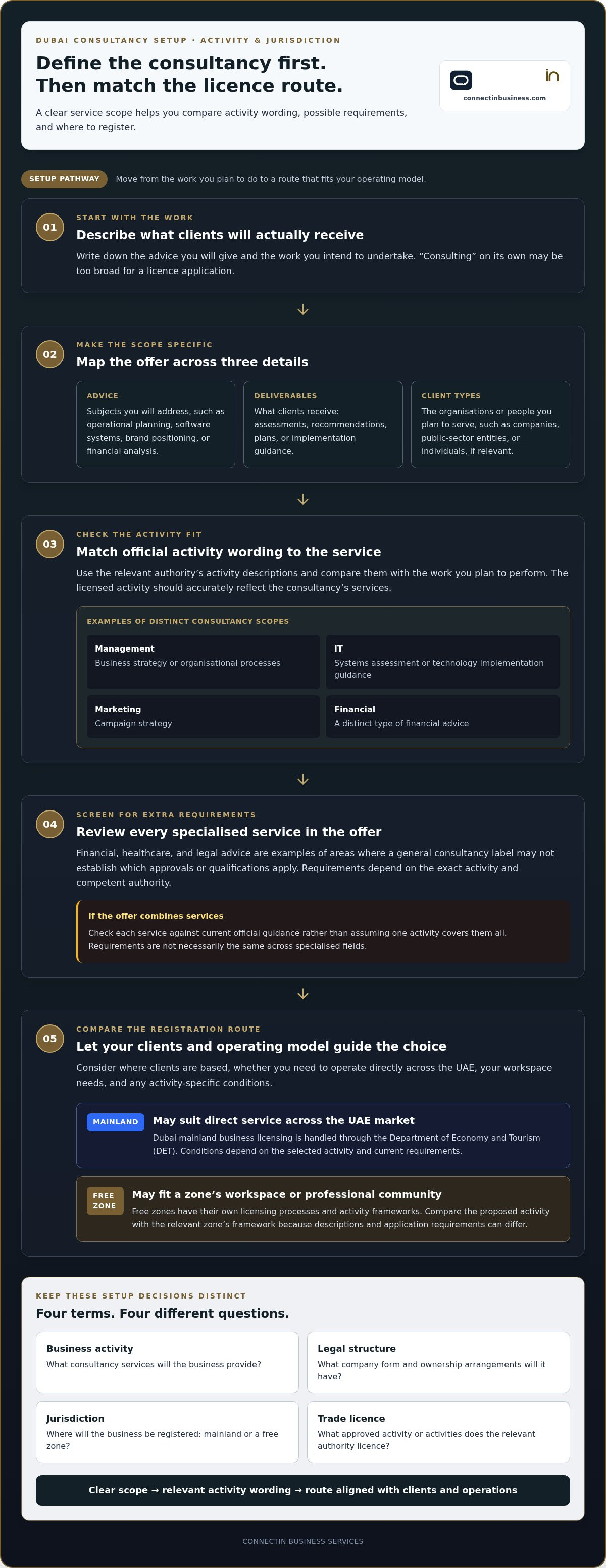
Start with the work itself, not a broad label. Write down the advice you will give, the deliverables clients will receive, and the types of organisations or individuals you plan to serve. This gives you a clear scope before you select official activity wording.
- Advice: Identify the subjects you will address, such as operational planning, software systems, brand positioning, or financial analysis.
- Deliverables: Specify whether clients receive assessments, recommendations, plans, or implementation guidance.
- Client types: Note whether you will advise companies, public-sector entities, or individuals, if relevant to your intended scope.
Then distinguish general business advice from specialised professional services. A company strategy review is not automatically the same activity as advice involving healthcare, legal matters, or financial services. Use the relevant authority’s official activity descriptions as the basis for your application, and compare the wording with the work you plan to perform. A trading name or broad phrase such as “business solutions” is not a substitute for a specific activity description.
Which consulting services may need additional review?
Requirements depend on the exact activity and the competent authority responsible for licensing or oversight. Financial, healthcare, and legal advice are examples of areas where a general consultancy label may not establish which approvals or qualifications apply. Requirements are not necessarily the same across these fields. Check the current rules for your specific activity and proposed scope before submitting an application.
Make a checklist of each service you intend to offer and compare it with current official guidance. If your offer combines different services, review each one rather than assuming a single activity covers them all. Clarifying the scope early helps you identify potential requirements and prepare an application that reflects the consultancy you intend to operate.
Choose a Dubai consultancy license structure that fits your operating model
Four related decisions shape your setup, but each answers a different question. The business activity describes the consultancy services you plan to provide. The legal structure defines the company form and ownership arrangements. The jurisdiction is where the business is registered, such as Dubai mainland or a free zone. The trade licence is issued through the relevant licensing authority and sets out the approved activity or activities.
Keeping these terms distinct makes it easier to compare your options. The suitable route depends on your activity, target clients, and operating model. Before choosing, consider where your clients are based, whether you need to operate directly across the UAE, what workspace the business needs, and whether your proposed activity has specific licensing conditions. The Dubai Chamber of Commerce’s Doing Business in Dubai resource provides wider context on the local business environment.
When a Dubai mainland consultancy setup may fit
A mainland setup may suit a consultancy intending to serve clients directly across the UAE market. Dubai mainland business licensing is handled through the Department of Economy and Tourism (DET). The application conditions depend on the selected activity and current requirements. This route may be relevant if your client development, service delivery, or growth plans rely on a broad local presence.
Consider your day-to-day work, not only the company’s address. For example, a consultancy expecting to work directly with organisations in different parts of the UAE may prioritise mainland access.
When a free-zone consultancy setup may fit
A free-zone option may suit a business whose operating needs, workspace preferences, or professional community align with a particular zone. Free zones have their own licensing processes and activity frameworks, so activity descriptions and application requirements can differ between jurisdictions. Compare your proposed activity with the relevant zone’s framework before settling on a route.
Consider where your clients are located and how you will deliver services. A consultancy focused on international clients or a particular business community may assess a free zone differently from one planning regular direct work in the wider UAE market.
Use these questions to test each option against your plan:
- Client access: Where are your intended clients, and how will you serve them?
- Activity fit: Does the jurisdiction offer a suitable activity description, and are additional requirements relevant?
- Workspace: What office or workspace arrangement fits your actual operating needs?
- Application process: Which authority will review the application, and what documents or approvals may apply?
ConnectIn Business Services supports founders comparing mainland and free-zone company formation as they shape a setup around their intended activities and operations.
Compare mainland and free-zone consultancy setups against your business priorities
Once you have shortlisted activities, compare jurisdictions against how the consultancy will serve clients. Dubai mainland licensing is handled through DET. Free-zone licences are issued through the relevant free-zone authority, each with its own activity framework and application process. The authority, permitted activities, and licence conditions matter more than the broad label attached to a setup.
Use the table as a decision framework, then verify the current requirements that apply to your proposed business. Conditions can vary by activity, legal structure, and authority.
| Comparison point | Dubai mainland | Dubai free zone |
|---|---|---|
| Client access | May suit a consultancy planning to serve clients directly across the UAE market. Assess the intended work and any conditions attached to the licence. | May suit an operating plan aligned with a particular zone. Check how the licence conditions relate to your intended clients and delivery model. |
| Activity fit | Review the activity descriptions and requirements provided through DET and any relevant competent authority. | Compare your planned services with the selected zone’s activity list and approval process. Frameworks can differ between zones. |
| Office expectations | Confirm what workspace arrangement applies to the chosen activity and legal structure. | Review the zone’s workspace options and any conditions linked to the licence or your intended operations. |
| Application considerations | Check the current application steps, documents, and activity-specific approvals with DET and relevant authorities. | Check the selected free zone’s application requirements, documents, and activity-specific approvals with its licensing authority. |
Which jurisdiction fits your target clients and services?
Map your likely clients by location, then consider how you will deliver the work. A consultancy expecting frequent direct engagement across the UAE may assess mainland licensing differently from one whose clients and operating needs align with a particular free zone. Neither pattern determines the answer on its own. The permitted activities and licence conditions must support the services you plan to provide.
For example, an IT consultancy delivering projects to clients in several emirates should consider its intended access and delivery arrangements. A specialist consultancy whose operations fit a particular zone can compare that zone’s activity framework against the same plan. Dubai Silicon Oasis and Meydan Free Zone are examples to research, not universal recommendations. When deciding how to open a consulting business in Dubai, assess your actual operating model rather than choosing by name alone.
What should founders compare beyond the licence itself?
Look beyond initial formation. Compare workspace arrangements, visa planning, renewal administration, and the practical needs of delivering your services. Separate one-time setup decisions from recurring obligations, and distinguish required arrangements from optional services. Office and visa arrangements can vary by jurisdiction, activity, and structure.
A structured review of client access, activity fit, workspace, and ongoing administration makes the jurisdiction decision more grounded and easier to revisit as the consultancy grows.
Follow these steps to apply for a consultancy license in Dubai
A clear sequence helps you organise the application without assuming every authority follows the same process. As you plan how to open a consulting business in Dubai, use the steps below as a general framework. Requirements can vary by jurisdiction, legal structure, and activity, so follow the current process set by the relevant licensing authority.
- Scope the activities. List the services you intend to provide and identify the corresponding official activity descriptions. Consider whether any part of the proposed scope may need additional approval or supporting documents.
- Select the jurisdiction and legal structure. Choose a mainland or free-zone route and a suitable company structure based on your clients, operations, and ownership plan. Confirm that the authority’s activity framework accommodates your intended services.
- Reserve a company name. Submit a proposed name through the relevant authority’s process and follow its naming requirements. Name approval and activity approval are separate considerations.
- Prepare the application documents. Assemble identity and ownership information, along with any forms or supporting material required for your chosen structure and activity.
- Submit the application. File through the relevant authority and respond to follow-up requests. Authority review and licence issuance are separate from later immigration, visa, and banking arrangements.
What documents should a founder prepare?
Use this as a preliminary checklist, not a definitive list. Authorities may request different material depending on the company structure, selected activity, and shareholder circumstances. Confirm the current requirements, including any format, validity, or certification rules, before submitting your application.
- Identity documents and contact details for shareholders and proposed managers
- Ownership information and documents relevant to the selected legal structure
- Application forms, proposed company name, and details of intended activities
- Supporting qualifications, experience records, or other activity-related material, if requested
Documents issued outside the UAE may need certified legal translation or attestation, depending on the document type and the authority’s acceptance requirements. Verify the required language, format, and authentication route before arranging either service.
What happens after submitting the application?
After submission, the licensing authority reviews the application and may request clarification, corrections, or additional documents. If your consultancy activity requires input or approval from another competent authority, that review may affect the application sequence or supporting evidence. Keep a record of submissions and follow-up requests so your responses remain consistent with the proposed activity and ownership details.
Licence issuance is an important milestone, but it doesn’t complete every launch task. Immigration file arrangements, visa applications, and banking processes are separate matters with their own requirements. ConnectIn Business Services supports company formation and licensing, alongside related PRO services, certified legal translation, and document attestation. Explore company formation and licensing support for help organising the setup process.
Prepare your Dubai consultancy for launch with licensing and administrative support
Receiving a trade licence is an important milestone, not the end of the setup process. A consultancy may still need to organise government-related procedures, immigration arrangements, business records, and documents for day-to-day operations. Keep the licence conditions accessible as you plan next steps, since requirements depend on the licensed activity, company structure, and authority.
ConnectIn Business Services supports founders with PRO services, certified legal translation, document attestation, trade licence amendments, and share transfers. These services can help coordinate company setup administration and later changes.
Which administrative tasks may follow company formation?
After formation, organise company records and track the procedures and documents needed for operations. If the consultancy changes its approved activities or other licence details, a trade licence amendment may be relevant. If ownership changes, share transfer assistance can help manage the related administrative process. The steps and supporting documents depend on the company and applicable authority.
Keep a record of what changed, when it changed, and which company documents or authority records may need updating. This creates a useful reference when the business expands its services, changes ownership, or prepares documents for official use.
Document processing may also involve certified legal translation or attestation, depending on the document and the receiving authority’s current acceptance requirements. Confirm the required format and procedure for each use. PRO support can assist with government-related administrative procedures, while founders remain responsible for understanding the obligations that apply to their business.
How can founders keep setup decisions organised?
Maintain one working checklist and update it as the consultancy moves from formation to launch. Store the approved activity wording, ownership details, submitted documents, licence information, and authority correspondence together. Record outstanding requests and who is responsible for each follow-up. This makes it easier to respond consistently if an application needs clarification or the business later needs to update its records.
- Licence and activity: Keep the issued licence and approved activities together, and note any conditions that affect the services offered.
- Ownership and company records: Maintain current shareholder details and record changes that may require administrative updates.
- Documents and correspondence: Save submitted copies, translations, attestations, and communications with relevant authorities.
- Tax matters: Review applicable registration and compliance responsibilities using current Federal Tax Authority guidance, and verify how they apply to your company and circumstances.
Administrative assistance is distinct from legal advice, direct court representation, and notary services. ConnectIn Business Services supports company formation, licensing administration, PRO procedures, translation, attestation, and later licence or ownership updates. Keeping clear records helps the business stay aligned with its licence as it develops.
Build your consultancy on a clear foundation
Turn your setup decisions into a business plan you can put into practice. As you consider how to open a consulting business in Dubai, keep your intended services and operating plans aligned as the consultancy develops. A growing client base or a change in ownership may prompt administrative updates, so clear company records from the outset can make future decisions easier to manage.
ConnectIn supports Mainland and Free Zone company formation across the UAE, with licensing assistance and PRO administrative support to help founders manage setup requirements. The relevant authority remains responsible for reviewing and determining licence requirements.
To move your plans forward, explore company formation and licensing support with ConnectIn.
Frequently Asked Questions
How much does it cost to open a consulting business in Dubai?
The total depends on jurisdiction, legal structure, activity, workspace, visas, and any required approvals. A licence-only figure may not represent the full first-year budget. Compare the authority’s licence charges with office arrangements, immigration costs, document processing, and renewal obligations. Request an itemised estimate based on your intended activity and structure, and distinguish mandatory charges from optional services before making a financial commitment.
Can I start a consulting business in Dubai while employed?
It may be possible, but don’t assume your current employment status has no bearing on company formation or consultancy work. Review your employment contract and check any applicable employer consent, work authorisation, or licensing conditions with the relevant authorities. Also consider whether your consultancy activities could conflict with your existing role. Resolve these questions before accepting clients or representing yourself as operating under a new business licence.
Do I need an office to open a consultancy in Dubai?
Workspace requirements depend on the jurisdiction, company structure, and selected activity. Some licensing arrangements may offer shared or flexible workspace options, while others may require a particular facility or tenancy documentation. Confirm the current conditions before budgeting or signing a lease. Also consider whether your consultants need a dedicated place to meet clients, store records, or carry out work, beyond the minimum licensing requirement.
How long does it take to get a consultancy license in Dubai?
There isn’t one reliable timeframe for every application. The process can depend on the licensing authority, activity, completeness of the documents, and whether another authority must review the proposed services. Requests for corrections or supporting information can add steps. Before planning a launch date, confirm the current process and allow for follow-up rather than making client commitments based on an assumed approval date.
Can a foreigner own a consulting company in Dubai?
Yes, foreign founders can own companies in Dubai, and 100% foreign ownership is permitted for most business activities in both mainland and free-zone setups. The applicable conditions can still depend on the activity, legal structure, and licensing authority. Check the current rules for the exact consultancy activity and how ownership details must be documented in the application. This is especially important if the company has multiple shareholders or a corporate shareholder.
Which documents are required for a consultancy license in Dubai?
Commonly requested items can include shareholder and manager identification, contact details, ownership information, application forms, and proposed activity details. Depending on the activity or shareholder circumstances, the authority may also request qualifications, experience records, or additional corporate documents. Treat these as examples, not a fixed checklist. Before submission, confirm document format, validity, translation, and attestation requirements.
Can a free-zone consultancy serve clients in Dubai mainland?
A free-zone licence generally supports activity within its jurisdiction and work for international clients, but it may not provide unrestricted access to the mainland market. The route for serving mainland clients depends on the activity and applicable rules. Arrangements such as using a distributor or establishing a mainland branch may be relevant in some cases. Confirm the permitted model with the free-zone authority and relevant mainland authorities before signing client contracts.
Does every consulting activity in Dubai need additional approval?
No. Whether additional approval is required depends on the specific consultancy activity and the competent authority’s current rules. General business advice may have different requirements from services involving financial, healthcare, legal, or engineering matters. Don’t infer approval needs from a broad label such as “consultancy.” Identify each service you plan to offer, then verify its activity classification, qualifications, and approval conditions before applying.


