

When starting a tech startup in Dubai, choosing a free zone or mainland setup is not necessarily the first decision. Begin by defining what your business will do, who it will serve and how it will deliver its product or service. Those details help identify the activities to include on a licence and the setup route that best fits your plans.
Mainland and free-zone options can suit different operating models, so compare them against your intended customers, activities and practical requirements. A clear comparison at the outset can help you avoid choosing a structure that does not fit the way you plan to operate.
This guide takes you from validating your business model to preparing for launch. You’ll learn how to describe your activities, compare Dubai setup routes and organise key documents and operational decisions. It also explains how company formation, licensing and PRO support can help structure the process.
Key Takeaways
- Starting a tech startup in Dubai begins with defining your services and intended customers, not choosing a setup route based on a broad technology label.
- Compare mainland and free-zone options against customer access, licensed activities, premises and staffing needs to find a route that fits your operating model.
- Plan the sequence before applying: define activities, shortlist setup routes, organise documents, submit the application and follow up on requirements.
- Plan formation and launch as separate workstreams, including documentation, banking, people, data, intellectual property and compliance.
- Use a practical roadmap to move from a validated business model to licensing and operational readiness, with company formation and administrative support helping organise the process.
Starting a Tech Startup in Dubai: Define the Business Before the Setup
A software company, digital platform and hardware business may all be described as “tech”, but that label alone does not determine the right company setup. Start by defining what the venture will sell, who it will serve and how it will operate. This gives you a practical basis for comparing licensing routes and preparing for company formation in Dubai.
Work through the decisions in sequence: clarify the business model, describe the activities behind it, then assess the market and operating requirements. This helps prevent a broad product description from hiding what the company will actually do.
Map the tech business model to real activities
Describe each planned revenue activity in plain language. A software product might involve developing and licensing an application. A technology consultancy may provide implementation or advisory services. A digital platform could operate an online service connecting users, while a hardware venture may sell or distribute physical devices. These are planning examples, not a substitute for selecting the applicable official activity classification.
Separate launch activities from possible future services. For example, a company may initially provide software access and later plan to add consultancy or hardware sales. Record these separately because adding activities can affect licensing requirements. Check the current classifications and procedures that apply before submitting an application.
- List what you will sell, deliver, license or operate. Name the specific service or product instead of relying on a broad label such as “technology”.
- Identify the main revenue activities. Note which services are central to launch and which are future plans that may need separate approval.
- Describe how delivery works. State whether customers receive a digital service, in-person support, cross-border delivery or a combination.
This activity map connects the startup concept to a licence application. It also gives company formation and licensing support a clear starting point.
Set Dubai market and operating assumptions
Write down who the business expects to serve. Customers may be UAE companies, consumers, international clients or a mix. Consider this customer base alongside the activities the company will perform when comparing setup options. For context on Dubai’s technology ecosystem, Dubai Silicon Oasis is a technology-focused free zone. Its presence does not mean every tech venture needs the same jurisdiction.
Make the operating model just as concrete. Record where founders and staff expect to work, where services will be delivered, and whether the venture anticipates hiring, needing premises or relying on business partners. Treat these as planning assumptions to test against the relevant setup options and authority requirements, rather than assuming a fixed staffing or premises requirement.
By the end of this stage, you should have a concise description of the product, target customers, revenue model, activities and operating plan. That is a stronger foundation for starting a tech startup in Dubai than choosing a setup based on the product category alone.
Mainland or Free Zone: Compare Dubai Setup Routes for a Tech Startup
There is no single setup route for every technology venture. A consultancy serving UAE companies, a software business selling internationally and a platform with several customer groups may each have different licensing and operating considerations. For founders starting a tech startup in Dubai, the useful question is which route aligns with the planned activities, customers and delivery model.
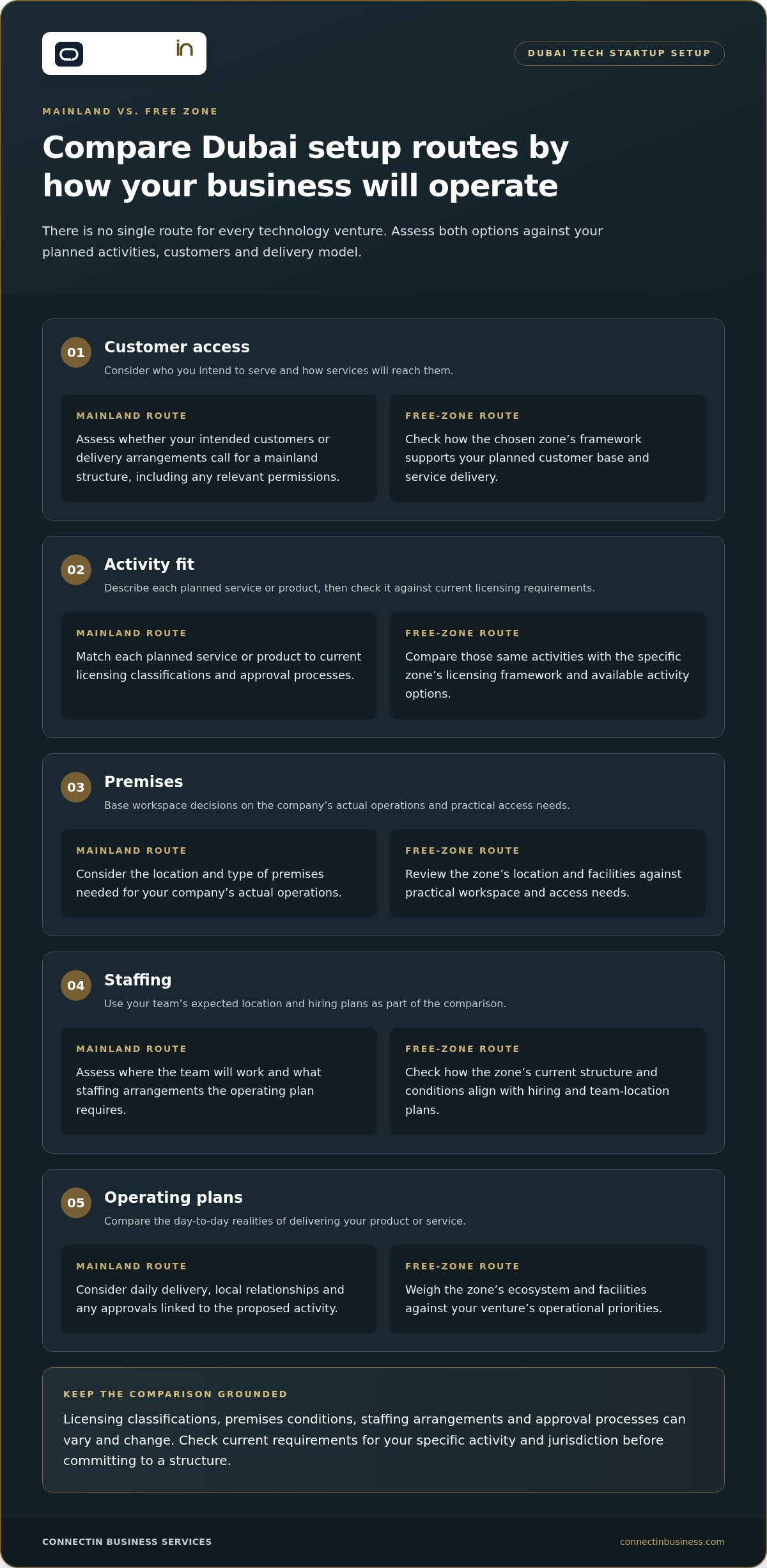
Use the comparison below as a decision framework. Licensing classifications, premises conditions, staffing arrangements and approval processes can vary and change. Check the current requirements for your specific activity and jurisdiction before committing to a structure.
| Decision factor | Mainland route | Free-zone route |
|---|---|---|
| Customer access | Assess whether the intended customers or delivery arrangements call for a mainland structure, including any relevant permissions. | Check how the chosen zone’s framework supports the planned customer base and service delivery. |
| Activity fit | Match each planned service or product to current licensing classifications and approval processes. | Compare the same activities with the specific zone’s licensing framework and available activity options. |
| Premises | Consider the location and type of premises needed for the company’s actual operations. | Review the zone’s location and facilities against practical workspace and access needs. |
| Staffing | Assess where the team will work and what staffing arrangements the operating plan requires. | Check how the zone’s current structure and conditions align with hiring and team location plans. |
| Operating plans | Consider daily delivery, local relationships and any approvals linked to the proposed activity. | Weigh the zone’s ecosystem and facilities against the venture’s operational priorities. |
When a Dubai mainland route may fit the plan
A mainland setup may be worth assessing when the company’s customer relationships, service delivery or day-to-day presence point toward operating through that structure. Begin with the proposed activities, then review the relevant licensing classifications and approval process. Assess premises and staffing assumptions at the same time. These factors work together, so a single customer type is not enough to determine the right route.
When a Dubai free-zone route may fit the plan
A free-zone route may suit a venture whose activities and operating model align with a particular zone’s framework. Compare its licensing options, location, facilities and business ecosystem with the startup’s practical needs. Dubai Silicon Oasis and DIFC Innovation Hub are examples of ecosystems, not interchangeable setup choices. Consider each location’s current relevance, terms and activity requirements before relying on it in a decision.
For a grounded comparison, document the intended activities, customer groups, delivery method, premises and staffing assumptions. Then assess mainland and free-zone routes against the same criteria. ConnectIn Business Services supports mainland and free-zone company formation, including company registration and licensing, helping founders turn a defined operating plan into a structured setup process.
Choose the Right Tech Activity and Licence Before You Apply
A licence activity should describe the services the company plans to provide, not just use a broad label such as “technology”. The company activity is the formal description used for licensing; the marketing description explains the offer to customers. Keeping the two distinct helps translate a commercial idea into a clear application. For those starting a tech startup in Dubai, activity selection can also affect which licensing route and additional approvals are relevant. Requirements depend on the authority and activity, so check current classifications and procedures before applying.
Prepare a precise activity description
Write a short, factual description of the product or service, how it will be delivered, who will use it and how the company will earn revenue. Building software differs from providing IT consultancy, operating a digital platform or trading hardware. A venture may plan more than one of these activities, but describe each clearly rather than grouping them under a generic technology category.
Flag specialist or potentially regulated activities for review against current authority requirements. Do not assume that a software-based service follows the same licensing path as software development or online trading. Describe the actual launch offer and identify future services separately, since they may require additional approval.
Use this sequence to move from the business model to an application:
- Define the activities. List what the company will provide at launch and describe each service in plain language.
- Shortlist routes. Compare mainland and free-zone options against the activities, customer model and operating plan.
- Prepare documents. Organise the founder, shareholder, proposed company-name and activity information required for the selected route.
- Submit the application. Follow the selected authority’s current process and provide the requested information in its specified format.
- Follow up. Track requests for clarification or supporting documents and respond through the relevant process.
Organize the company formation application
Before submission, assemble a working file containing each founder’s and shareholder’s details, the proposed company name, the ownership information required for the application and a clear activity description. Keep details consistent across forms and supporting documents. Formats and approval steps can vary by authority and applicant circumstances, so follow the requirements for the chosen route rather than assuming one checklist applies everywhere.
ConnectIn Business Services supports Mainland and Free Zone company formation, including company registration and licensing, alongside PRO and administrative support. This helps founders coordinate setup around the activities they intend to carry out. If the company’s services change after launch, review whether the licence should be amended before adding them. A precise activity description gives the setup a clearer foundation and helps keep the formal licence aligned with the business plan.
Prepare for Launch: Documents, Operations, and Compliance in Dubai
Company formation establishes the legal structure and licence, but it does not complete every task required to operate. Banking, hiring, customer contracts, data handling and compliance planning may continue after licensing, each with its own process and requirements. Treat them as parallel workstreams. Incorporation does not guarantee a bank account, funding, visas or a particular regulatory outcome.
Build a founder-ready document and administration file
Keep a central file of information and documents relevant to the chosen application. Organise founder and shareholder identity details, ownership information, proposed company details, the business plan and intended activities. Requirements depend on the authority, application route and applicant circumstances, so follow the current instructions for the specific setup rather than relying on a generic checklist.
Some documents may need translation or attestation, depending on their type and the process requirements. ConnectIn Business Services supports founders with certified legal translation, document attestation and PRO services, alongside company formation and licensing administration. Coordinating these tasks can help keep application records consistent and make administrative follow-up easier to manage.
Plan the first operating decisions after formation
Assign separate owners to key launch workstreams. For banking, prepare the company information and supporting records requested through the bank’s process, while treating account opening as a separate decision. For people, map hiring plans and related administration to the company’s actual needs. For contracts, document the customer terms, supplier arrangements and approval responsibilities needed to deliver the service.
Technology ventures should decide how they will handle customer and employee information, control access to it, and manage intellectual property such as software, product designs, brand assets and related agreements. Establish an accounting process and refer tax, data and other regulatory questions to current authoritative guidance. Requirements can vary by activity and circumstance, so avoid relying on general summaries for a specific compliance decision.
Maintain a calendar of recurring obligations and name the person responsible for tracking each one. Record key dates, documents to retain and who approves submissions or changes. This simple control helps prevent important administration from being overlooked as the team focuses on launch.
Pre-launch readiness checklist: “Documents organised, responsibilities assigned, banking and hiring processes underway, data and intellectual property plans recorded, and recurring compliance dates tracked.”
For practical support with company formation and related administration, review company formation and corporate support options.
Turn Your Dubai Tech Startup Plan into a Company Setup Roadmap
A company setup is easier to manage when each decision follows from the one before it. For founders starting a tech startup in Dubai, the appropriate route depends on the company’s activities and operating plans, not simply its technology label. Use this roadmap to carry your plan from initial definition through formation and launch preparation.
- Finalize activities. Confirm what the company will provide at launch and describe each planned service or product clearly.
- Compare routes. Assess mainland and free-zone options against customer access, activity fit and operating requirements.
- Prepare documents. Organise founder, shareholder, company-name and activity information for the chosen application.
- Submit and follow up. Use the selected authority’s current process and track any requests or next steps.
- Organise launch. Assign owners to banking, people, administration and other operational work that continues after licensing.
Know what to bring into a setup discussion
A concise preparation note can make a formation discussion more focused. Summarise the product or services, intended customers and planned revenue activities. Add your preferred ownership structure, location, premises and staffing assumptions, along with your intended launch timing. These are planning inputs, not fixed requirements, and help shape a route assessment around the venture’s intended operations.
Include any expected document translation or attestation needs, as well as government-process or administrative support requirements. Keeping these items together helps distinguish tasks for the formation application from those that need separate attention as the business prepares to operate.
Move from planning to supported formation
Once the activity and operating plan are clear, company formation support can connect those decisions to registration and licensing steps. ConnectIn Business Services supports formation across Mainland and Free Zone routes, with licensing and PRO administration support. If the business later changes its activities, trade licence amendments may also be relevant, subject to the applicable process and requirements.
Keep the plan adaptable. Authority procedures and activity requirements can change, and operational needs may develop after launch. Maintain a record of selected activities, application documents, decisions and follow-up responsibilities so the company has a useful reference as it moves from setup into day-to-day operations.
With the core decisions organised, you can move forward with a clearer understanding of what the company intends to do and which setup questions need to be resolved. Discuss your Dubai company formation requirements.
Build a Setup That Can Support Your Next Stage
A sound setup should serve the business you are building now and give you a clear process for responding when its activities or operating needs change. Keep key decisions documented and revisit them when the company’s services, customer base or team structure develops. This creates a practical reference for future licensing and administrative decisions.
For founders starting a tech startup in Dubai, ConnectIn Business Services supports Mainland and Free Zone company formation across the UAE, together with company licensing and PRO administration. This support connects your chosen route and planned activities with the formal setup process while helping coordinate related administrative work.
Take the next step with a concise outline of your planned activities, ownership preferences and operating requirements. Plan your Dubai company formation next steps with support tailored to your formation requirements.
A well-prepared plan gives your technology venture a more confident start and a clearer foundation for growth.
Frequently Asked Questions
Can a foreign founder start a tech startup in Dubai?
Yes, foreign founders can explore establishing a business in Dubai, but the suitable structure and process depend on the planned activities and chosen jurisdiction. Outline ownership, intended services and customer locations, then check the current requirements with the relevant authority for your circumstances. Company formation is separate from residency or visa applications, which have their own eligibility criteria and procedures. Plan the two processes independently.
Does a tech startup in Dubai need a special technology licence?
Not necessarily. The relevant licence activity should describe what the company will actually do, such as develop software, provide IT consultancy or operate a digital platform. A broad “technology” description may not capture every planned service. For example, a business that also sells hardware should consider whether that activity needs to be addressed separately. Classifications and additional approvals depend on current authority rules and the venture’s specific activities.
Can a Dubai tech startup apply for funding or accelerator support?
Yes, a startup can explore funding and accelerator programmes, but these are separate from company formation and are not guaranteed. Eligibility may depend on the programme, sector, business stage and application criteria. Dubai Chambers’ startup resources include funding-related topics that can help founders identify areas to investigate. Review each programme’s current terms and application requirements, then assess whether its focus aligns with your venture before applying.
Does setting up a company in Dubai automatically provide a residence visa?
No. Company formation and residency or visa processes are distinct, so establishing a company does not by itself confirm that a founder will receive a residence visa. Eligibility, required documents and procedures may depend on the chosen structure and current rules. Treat the visa application as a separate planning task, and consult applicable UAE government guidance for your circumstances before making travel or relocation decisions.
What should a tech startup consider before opening a UAE business bank account?
Prepare for a separate onboarding process. Banks apply their own current procedures, and an application does not guarantee account approval or a fixed decision time. Organise company records, ownership details, a clear description of licensed activities and supporting documents. It can also help to explain expected business transactions, such as how the company will receive customer payments and pay suppliers, so the application gives a coherent picture of operations.
How should a Dubai tech startup protect its intellectual property?
Identify the venture’s software, brand assets, designs and other intellectual property early, then document who owns each asset and what rights the company holds. For example, record ownership and permitted use in agreements with founders, employees and contractors. Protection routes depend on the asset and relevant legal framework, so seek appropriate guidance for specific decisions. Company formation alone does not register or protect intellectual property.


