

A cancelled trade licence does not, by itself, complete a controlled company closure. If you’re unsure which authority governs the process or what obligations remain, company liquidation services in Dubai can help organise the steps involved. Closing a business may require more than submitting a cancellation request: missing documents, unresolved liabilities or outstanding compliance matters can complicate the process.
The right route depends on whether your company is licensed on the mainland or in a free zone. This guide explains what to prepare, how authority requirements can differ and how administrative and document coordination fit into the process. It also outlines when legal, tax or financial questions need specialist attention.
ConnectIn Business Services provides company liquidation support alongside PRO and administrative services, certified legal translation and document attestation. The sections ahead explain the key dependencies to consider and how to prepare for a more organised closure.
Key Takeaways
- Company liquidation services in Dubai help organise a company’s closure. Liquidation is not the same as simply stopping business activity or cancelling a licence.
- Start by identifying whether your company is mainland or free zone licensed. The relevant authority and closure requirements can differ.
- Reduce avoidable follow-up by organising company records, ownership details, known obligations, approvals and authority-specific documents.
- Clarify the scope of liquidation support, including responsibilities, milestones, communication and document coordination.
- Prepare a first-step file with your entity details, licence information, ownership records and any known outstanding obligations.
Dubai Company Liquidation Services: Process and Timing
Closing a business may be a considered decision after operations have run their course or the company’s direction has changed. The first step is to identify the route that applies to your entity. Company liquidation services in Dubai can help organise the closure around the company’s licence, governing authority and outstanding obligations. The sequence and timing depend on these details, so one checklist will not fit every business.
Liquidation is the orderly winding down of a company. It can involve reviewing the company’s position, addressing its obligations and completing the relevant closure procedures. A general overview of company liquidation explains the broader concept, but Dubai requirements depend on the entity and its licensing authority. For mainland companies, the relevant Dubai licensing route generally involves the Department of Economy and Tourism (DET). Free zone companies follow the procedures set by their own authority.
Liquidation addresses the company’s orderly wind-down; licence cancellation records the end of its permission to operate. Neither term should be assumed to cover every other closure requirement. This distinction helps explain why stopping trading or cancelling a licence may not complete all the steps involved in closing an entity.
Liquidation, licence cancellation, and de-registration: how they differ
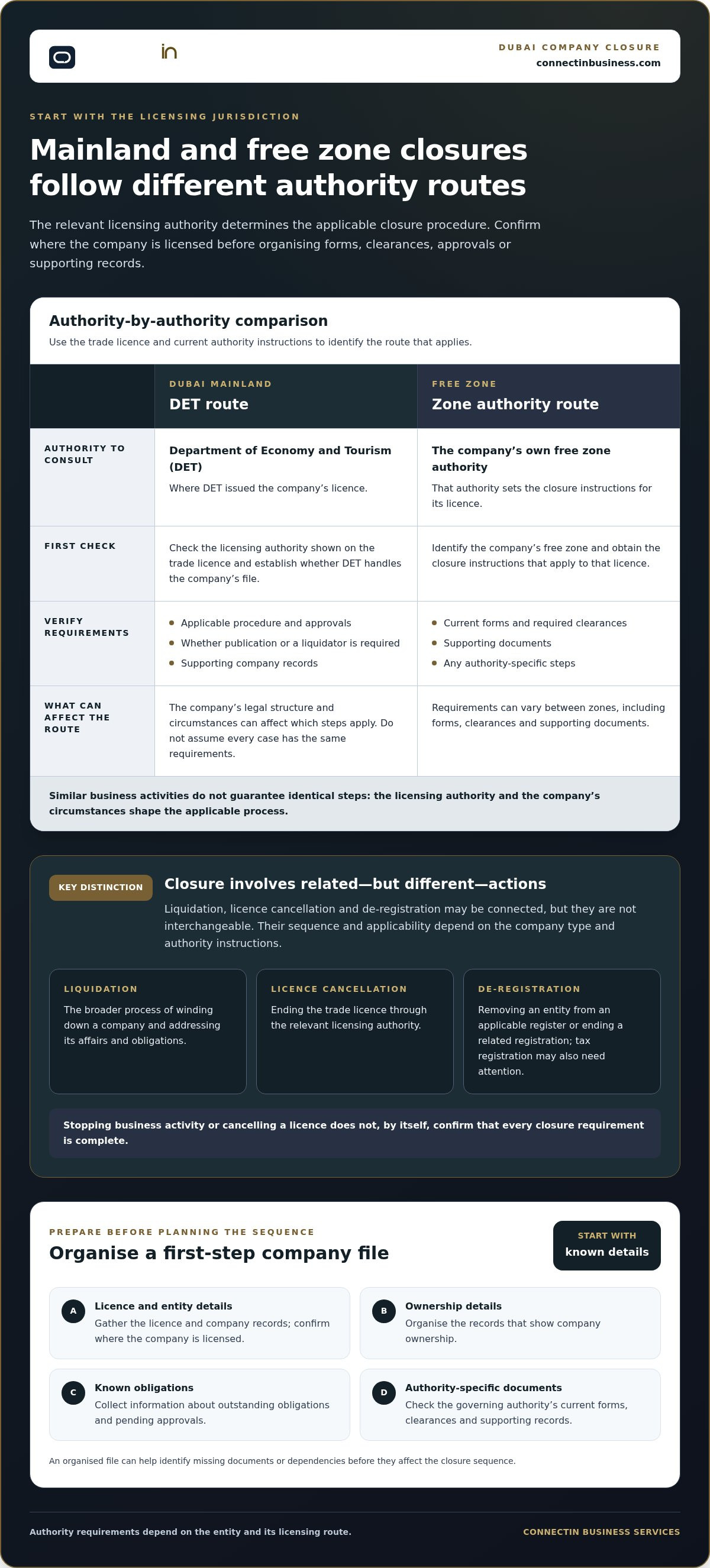
Liquidation describes the broader process of winding down a company and addressing its affairs. Licence cancellation concerns ending the trade licence through the relevant licensing authority. De-registration generally refers to removing an entity from an applicable register or ending a related registration. The term can also arise in tax contexts, where a separate registration may need attention. These actions may be connected, but they are not interchangeable. Their sequence and applicability depend on the company type and authority instructions.
For example, a business may have stopped serving customers but still need to organise company records, clarify outstanding obligations and complete authority-specific formalities. Inactivity does not mean the closure is complete. A coordinated review helps identify the processes that apply before you begin taking steps.
When a Dubai business may consider liquidation support
Liquidation support can be useful when owners have decided to close a business, are implementing a restructuring that includes winding down an entity, or need an administrative plan for bringing the company to an end. It can help organise documents and PRO-related coordination while keeping responsibilities clear. The right route depends on the company’s circumstances, particularly if it is inactive or financially distressed.
Start preparing early. Gather the licence and company records, ownership details, and information about known obligations or pending approvals. Then identify whether the entity is mainland or free zone licensed and which authority governs its closure. This initial review can uncover missing documents or dependencies before they affect the sequence. An organised file also gives company liquidation services in Dubai a practical starting point for administrative support.
How Dubai mainland and free zone liquidation requirements can differ
Start by confirming where the company is licensed. Mainland and free zone entities may have different closure instructions, forms and dependencies, so do not treat one company’s process as a universal UAE checklist. The relevant licensing authority determines the applicable closure procedure. Identifying that authority early helps you find the right requirements and prepare relevant records.
For mainland companies, the Dubai Department of Economy and Tourism (DET) is the relevant licensing authority where it issued the licence. The company’s legal structure and circumstances can affect the route. The UAE Federal Decree-Law No. 32/2021 on Commercial Companies provides legal context for company matters. Practical closure steps should be checked against current instructions from the authority responsible for the entity.
A free zone company follows the closure process set by its own free zone authority. Requirements can vary between zones, including the forms, clearances and supporting documents requested. Even companies with similar activities may need different administrative steps because their licences are governed by different authorities.
| Jurisdiction | Authority to consult | Details to verify |
|---|---|---|
| Dubai mainland | DET, where it issued the licence | Applicable procedure, approvals, publication or liquidator requirements, and supporting records |
| Free zone | The company’s own free zone authority | Current forms, required clearances, documents, and any authority-specific steps |
Mainland company closure in Dubai
For a mainland entity, begin with the licensing authority shown on its trade licence and establish whether DET handles its file. The company’s structure and circumstances may affect which closure steps apply. Do not assume that every case requires the same approval, creditor publication or liquidator appointment. Check these points against current authority instructions and the company’s circumstances before planning the sequence.
Free zone company closure in Dubai
For a free zone entity, its own authority sets the applicable closure instructions. Find out which forms, clearances and supporting documents are required for that licence and how the authority expects them to be submitted. Avoid relying on another zone’s checklist, even if the businesses appear similar. Establishing the current requirements at the outset helps you prepare a relevant document file.
Identifying the jurisdiction is also a useful starting point for company liquidation services in Dubai. An administrative support partner can help organise documents and PRO-related coordination around the relevant authority route. ConnectIn Business Services provides company liquidation and administrative support. Learn more about company liquidation support as you plan the closure.
What can delay company liquidation in Dubai, and how to plan for it
An incomplete or mismatched file can lead to additional authority follow-up and slow progress. A missing ownership record, inconsistent company details across documents or an unresolved obligation may prompt questions before the next step can proceed. Prepare a clear company file and identify dependencies early. The evidence requested depends on the entity, its circumstances and the relevant authority’s instructions.
Records and obligations to organise before starting
Start by assembling the records that show who the company is, who owns it and what remains open. A useful preparation checklist is: organise the current trade licence, company records, ownership details, relevant correspondence and a working list of known obligations. Treat this as a starting point, not a complete authority checklist.
Compare the details across documents before submitting anything. If, for example, the licence and ownership records show different company details, flag the discrepancy and gather documents that explain it. Keep a record of pending applications, approvals or correspondence with the licensing authority so the closure plan accounts for matters already in progress.
Map obligations that may need attention, where applicable:
- Employee matters, including processes or records connected with staff.
- Supplier and creditor balances, disputed amounts or outstanding correspondence.
- Tax registrations, returns or other tax-related matters requiring review.
- Utility accounts or other service arrangements linked to the company.
- Approvals, permits or clearances that may relate to the company’s activity.
This is a planning exercise, not a determination of what the law requires. The licensing authority or a suitably qualified professional adviser can determine which evidence and actions apply to a specific company. Keep copies in a consistent file structure and note who is responsible for supplying or resolving each item. That makes gaps visible before they lead to avoidable back-and-forth.
Authority clearances and tax considerations
Clearances depend on the entity, its business activity and the closure instructions of its licensing authority. A requirement for one company may not apply to another. Before treating a clearance as necessary or complete, establish which body issues it, what evidence it expects and whether a related matter is still pending. Authority procedures and document requirements can change, so use current instructions for the company’s jurisdiction.
Tax matters need a separate review. If the company has tax registrations, establish whether deregistration, filings or other steps apply and coordinate the review with the Federal Tax Authority (FTA) as relevant. Do not rely on a general checklist for deadlines, required returns or possible consequences. These details depend on the company’s circumstances and current rules, so have them verified by an appropriate tax adviser or through current FTA guidance.
Company liquidation services in Dubai can include administrative and document coordination to help keep the file organised. ConnectIn Business Services provides liquidation alongside PRO and administrative support, helping owners organise information and track responsibilities without assuming one standard document pack suits every company.
How to assess company liquidation support in Dubai
Clear scope is central to effective closure support. Before proceeding, establish what the company needs, which authority governs its file and who will handle each responsibility. This separates administrative coordination from specialist work and gives everyone a shared view of the next steps. Use this four-part review to assess whether the support fits your company’s situation.
- Confirm the entity details. Record the company’s legal name, licence type, licensing jurisdiction, ownership information and intended closure. Include known outstanding matters so the scope reflects the company’s circumstances.
- Identify the authority route. State which licensing authority governs the company and make clear that the process will follow its applicable instructions. The mainland and free zone distinction matters because requirements and documents can vary.
- Agree the responsibility split. Clarify which tasks involve administrative or PRO coordination, which documents the company must supply and who will address specialist legal or financial matters.
- Set out coordination practices. Define the expected milestones, document ownership, communication channel and approach to authority follow-up. A clear plan makes it easier to see what is pending and who is responsible.
Define the company’s closure scope and responsibilities
ConnectIn Business Services provides company liquidation alongside PRO and administrative services. A written scope can identify the entity, licensing jurisdiction, known obligations and intended closure, then set out the administrative coordination and documents needed to progress the work. Keep any specialist legal or financial matters distinct from administrative support. If a matter involves court proceedings, distinguish case-related assistance from representation before the court.
Discuss company liquidation services in Dubai in terms of defined responsibilities, not assumed outcomes. Agree how progress will be recorded, how authority queries will be communicated and which items remain with the company. Milestones can describe stages of coordination without promising a fixed completion date or approval. The applicable authority and the company’s circumstances shape the process.
Understand documentation and communication support
Documentation may involve records in different formats or languages. Where relevant, certified legal translation and document attestation can support paperwork used in a closure process. The exact documents depend on the entity and authority instructions, so do not treat any sample list as exhaustive.
Good coordination is practical and transparent. Establish who provides each record, who checks that the file is organised, how document versions are tracked and where updates will be shared. If the authority requests further information, a clear communication channel and responsibility split help the company respond in an orderly way. These practices support visibility; they do not guarantee authority approval or a particular timeline.
For structured administrative coordination around your company’s closure, discuss company liquidation support with ConnectIn.
Start your Dubai company liquidation with an organised next step
A clear starting file makes it easier to discuss the closure route and identify what needs attention. Before arranging support, collect the company’s basic details and note any open matters. You don’t need to resolve every issue before starting, but separating confirmed information from unanswered questions helps define a practical scope for company liquidation services in Dubai.
A practical first-actions checklist for business owners
Prepare a concise overview of the entity and its current position. Use this checklist to get started:
- Identify the jurisdiction. Confirm whether the company is licensed on the Dubai mainland or in a free zone, and locate the licensing authority shown on its records.
- Gather core company information. Assemble the current trade licence, company records, ownership details and relevant authority correspondence.
- List known obligations. Note outstanding employee, supplier, creditor, utility or other company matters where applicable. Include pending approvals and applications.
- Separate unresolved questions. Record legal, tax and financial issues that need specialist review rather than treating administrative coordination as a substitute for that advice.
- State the intended outcome. Summarise why the company is closing and any known circumstances that may affect the closure plan.
This does not need to be a definitive authority submission pack. It is a working overview that helps clarify the company’s circumstances, reveal missing information and support a focused discussion about responsibilities and next steps. Requirements depend on the entity and its licensing authority.
How ConnectIn supports the closure process
ConnectIn Business Services provides company liquidation in Dubai alongside PRO and administrative services. This support helps organise closure-related coordination and documentation around the company’s situation. A clear starting summary gives the discussion a useful foundation: the entity type, licensing authority, ownership, known obligations and intended closure.
Some paperwork may require language or document formalities. Where relevant, ConnectIn’s certified legal translation and document attestation services can support the paperwork involved. Their relevance depends on the documents and requirements that apply to the company, so they are supporting services rather than a universal requirement for every closure.
Keep responsibilities clear. Administrative coordination can help organise information and track document-related tasks, while unresolved legal, tax or financial questions need appropriate professional handling. An initial discussion can establish the scope, communication approach and documents to organise without assuming a fixed timeline or guaranteed authority decision.
To take the next step, discuss company liquidation support with ConnectIn and outline your company’s jurisdiction, licence, ownership details and known obligations.
Move forward with a clear closure plan
Closing a company is also an opportunity to give owners, partners and stakeholders a clear account of what happens next. Before taking action, decide who will coordinate the process internally and keep a central record of decisions, documents and pending questions. A concise brief can make the first discussion more focused and turn an uncertain task into an organised work plan.
ConnectIn Business Services provides company liquidation support alongside PRO and administrative assistance. Where paperwork requires it, certified legal translation and document attestation can support the documentation process. This administrative coordination helps keep responsibilities and records in view, while specialist legal, tax or financial questions remain separate matters.
If you’re ready to establish a practical route for your business closure, discuss your Dubai company liquidation requirements with ConnectIn. Company liquidation services in Dubai can help you approach the next stage with greater clarity and an organised plan.
Frequently Asked Questions
How long does company liquidation take in Dubai?
Timing varies by jurisdiction and complexity. As a planning estimate, mainland liquidation commonly takes 3 to 6 months and may extend to 18 months in complex cases. A straightforward free zone closure may take 2 to 6 weeks, with some cases extending to 2 to 4 months. These are not guaranteed timelines. Authority review, unresolved obligations and document corrections can affect the schedule for company liquidation services in Dubai.
What documents are required for company liquidation in Dubai?
There is no single document list for every Dubai company. The licensing authority and company circumstances determine what it requires. A practical starting file may include the trade licence, company formation and ownership records, shareholder or manager details, and relevant authority correspondence. Depending on the case, records relating to staff, creditors, tax registrations or approvals may also be needed. Treat this as preparation, not a complete submission checklist.
Can I liquidate a Dubai company if it has outstanding debts?
Outstanding debts need to be identified and addressed as part of planning the closure. Prepare a clear schedule of creditors, disputed amounts, payment status and supporting correspondence. If the company may be unable to meet its obligations, don’t assume a standard administrative closure is appropriate. The company’s financial position can affect the route, so obtain qualified legal or insolvency advice before deciding how to proceed or communicating with creditors.
Is the liquidation process different for a Dubai mainland and free zone company?
Yes. A mainland company follows the process of its relevant Dubai licensing authority, while a free zone company follows its own zone’s instructions. Forms, clearances and supporting documents can vary across free zones. First confirm the authority named on the company’s licence, then use its current closure guidance. A checklist prepared for a different jurisdiction may not address your entity’s requirements.
Do I need an auditor or liquidator to close a company in Dubai?
It depends on the company’s legal form and licensing authority. Current guidance indicates that mainland LLCs generally require a licensed liquidator, and that the appointee cannot be the company’s current or recent auditor. Some free zone authorities may not require a liquidator. An auditor and liquidator have different roles. Verify current appointment requirements with the relevant authority and seek professional advice for your entity.
Does company liquidation in Dubai include tax deregistration?
Not automatically. If the company has Corporate Tax registration, current guidance generally requires an application for deregistration within three months of cessation. VAT-registered businesses generally apply within 20 business days of ceasing taxable supplies, and an applicable final Corporate Tax return may also be required. Confirm which obligations apply, the relevant dates and any consequences with the Federal Tax Authority (FTA) or a tax adviser.
Can a business continue operating while its Dubai company liquidation is underway?
Don’t assume the company can continue normal trading once closure is underway. Whether any activity can continue depends on the company’s licence status, authority instructions and the stage of the process. Before accepting new work, issuing invoices or entering commitments, clarify what is permitted for that entity. Keep essential records of transactions and decisions, and seek advice if activity is needed to manage assets or meet existing obligations.


