

The cost to liquidate a company in UAE depends on its jurisdiction, liabilities, employees, visas and outstanding compliance work, so there is no single figure for every business. Simply stopping trading does not close a company legally: it must complete liquidation and deregistration.
It’s understandable to focus first on the expected expense. The total may be affected by licence cancellation, liquidator and reporting requirements, employee matters, unpaid liabilities and tax deregistration. Understanding these items helps you plan the closure and avoid assuming a company is closed while it remains legally active.
This guide explains the steps involved in closing a Dubai company, the factors that shape the overall cost and how mainland and free zone processes differ. It also covers compliance tasks that can add complexity, helping you identify what needs attention before moving forward.
Key Takeaways
- Build your closure budget around the company’s structure and complexity, including outstanding liabilities, employees and compliance requirements.
- Separate authority charges from liquidator, reporting and visa-related costs to see which parts of the process are driving your total.
- Identify whether your company is mainland or free zone early, as the authority and closure requirements affect the steps involved.
- Plan for the full deregistration process, not just the end of trading, and address tax, employee and creditor matters along the way.
- Start preparing documents and resolving outstanding obligations early to reduce avoidable delays and added costs.
What Is Company Liquidation in Dubai?
Liquidation formally closes a UAE company, settles its obligations and completes deregistration. Estimate costs based on the company structure, solvency, outstanding liabilities and required compliance work.
- Separate voluntary closure from insolvency proceedings. Voluntary liquidation is generally cheaper than court-mandated compulsory liquidation, while debts and unresolved liabilities can add work and expense.
- Use complexity-based totals as planning benchmarks.
- Compare these ranges with the company’s structure.
Compare Solvent and Insolvent Costs
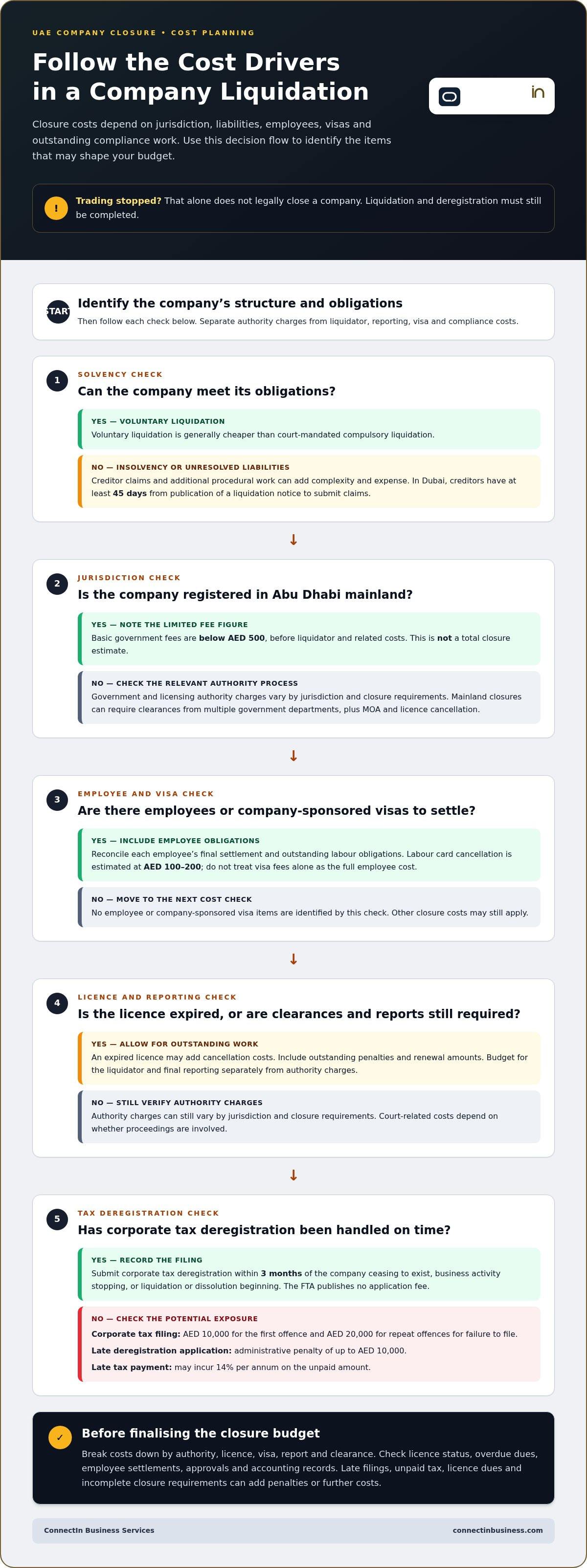
First establish whether the company can meet its obligations. Are UAE company liquidation costs different for solvent and insolvent companies? Yes. Voluntary liquidation is generally cheaper than court-mandated compulsory liquidation, and insolvency can involve creditor claims and additional procedural work. Creditors have at least 45 days from publication of a liquidation notice in Dubai to submit claims.
- Allow for greater complexity where debts, assets and audit work exist.
- Factor in location. Abu Dhabi mainland company liquidation has basic government fees below AED 500, before liquidator and related costs. This is not a total closure estimate.
Account for Tax Deregistration Costs
Include tax closure and outstanding compliance in your budget. What is the typical cost to liquidate a company in the UAE? Tax penalties and unpaid charges can increase the total.
- Submit corporate tax deregistration within 3 months of the company ceasing to exist, business activity stopping, or liquidation or dissolution beginning. The FTA publishes no application fee.
- Budget for late filing exposure. Late corporate tax filing may result in penalties. Failure to file attracts AED 10,000 for the first offence and AED 20,000 for repeat offences.
- Account for a late corporate tax deregistration application, which can incur an administrative penalty of up to AED 10,000. Late tax payment may also incur 14% per annum on the unpaid amount.
- Allow for timing and completeness. What penalties or extra costs can arise from delays, unpaid fees, or incomplete UAE company liquidation? Late filings, unpaid tax, licence dues and incomplete closure requirements can add penalties or further costs. Check each obligation before finalising the budget.
Use the legal framework as a final control. According to the UAE Legislation Portal, Federal Decree-Law No. 32 of 2021 is the UAE Commercial Companies Law, and directors who fail to initiate liquidation when required can be held personally liable for company debts.
Variable licence cancellation, liquidator, audit and visa costs
Create a separate cost line for each cancellation, clearance, report and employee obligation. Government, licensing authority and court fees vary. Government and authority charges depend on jurisdiction and closure requirements; court-related costs apply if proceedings are involved.
-
Arrange Government Clearances
List the relevant authorities and complete their clearances before submitting the final deregistration application. Mainland closures can require clearances from multiple government departments, along with MOA and licence cancellation.
-
Settle Employees and Cancel Visas
Reconcile employee dues and company-sponsored visas before closing the licence. Labour card cancellation is estimated at AED 100 to AED 200. Include each employee’s final settlement and any outstanding labour obligations in your accounting, rather than budgeting for visa fees alone.
-
Include Liquidator and Audit Costs
Budget for the liquidator and final reporting separately from authority charges. Court-related costs depend on whether proceedings are involved. Government charges alone do not provide a complete estimate when creditor or court processes apply.
- Request a breakdown of costs by authority, licence, visa, report and clearance.
- Check the licence status and any overdue renewal dues. An expired licence may add costs to cancellation charges, so include outstanding penalties and renewal amounts in your closure budget.
- Match each cost to the responsible party and required document. This makes it easier to identify missing approvals, employee settlements or accounting records before submitting the liquidation report.
For help coordinating the closure process, company liquidation support can help organise the required steps.
Liquidation timelines and expedited processing
Set a working schedule based on the company type, outstanding obligations and authority clearances. A faster submission cannot bypass required deregistration steps or creditor notice periods.
-
Compare Timelines by Company Type
Identify the registered jurisdiction before setting a target. A Dubai mainland LLC typically takes 3–6 months; complex liabilities can extend closure to 6–12 months or longer. Closure timelines can vary between free zone companies and mainland sole establishments, depending on the circumstances. DMCC liquidation typically takes 2–3 months, and RAKEZ closure can take up to 90 days.
-
Estimate the Company Closure Timeline
Map each required clearance, notice and report against the closure sequence. A standard Dubai company liquidation normally takes 1–3 months, while a solvent, simple mainland LLC may take 2–4 months. A solvent, simple UAE free-zone entity typically takes 1–3 months. These estimates differ because company structure and authority procedures determine the work involved.
- Build the creditor notice period into the schedule. In Dubai, creditors have at least 45 days from publication of the liquidation notice to submit claims. The notice period runs alongside other preparation only where the relevant authority’s process permits; it cannot be removed simply by submitting documents sooner.
- Allow time for tax deregistration and final submissions. The Federal Tax Authority’s review window for a completed corporate tax deregistration application is 40 working days. If the FTA requests additional information, the company has 60 calendar days to resubmit. VAT deregistration processing typically takes 20–40 business days.
- Prepare early rather than relying on expedited processing. Start the Dubai closure process 6 to 8 weeks before the trade licence expires. Gather corporate records, settle obligations, cancel visas and obtain clearances before applications are filed. Missing documents, unpaid dues or a delayed liquidation report can extend the schedule; an expedited package cannot bypass required legal or authority steps.
- Track renewal dates and each application milestone in one closure plan. An inactive company may remain legally active until licence cancellation and regulatory clearances are complete. Record the submission date, authority response, outstanding document and responsible party for each step. This helps reveal bottlenecks early and keeps deregistration, employee matters and final reporting aligned.
Mainland and free zone liquidation cost differences
Compare the registered structure and authority before estimating closure costs. For mainland LLCs, appoint a licensed liquidator; mainland creditor notices appear in two local newspapers, including one in Arabic, and creditors have at least 45 days to submit claims.
- Identify whether the entity is mainland, free zone or a foreign branch. Mainland procedures involve clearances from multiple government departments, while each free zone authority sets its own deregistration fees and document requirements. A foreign branch follows the relevant authority’s closure process, so assess its structure and outstanding obligations separately.
- Separate mainland licence cancellation charges from professional fees and other closure expenses. These are cancellation charges, not a complete liquidation total.
- Check the free zone’s current fee schedule and closure process. Fees and procedures differ because each authority sets its own requirements.
- Use authority examples to compare likely cost components, not to assume that one zone’s charges apply elsewhere.
- Confirm the liquidator and notice requirements before budgeting mainland work. A licensed liquidator must be appointed for mainland LLC liquidation. Mainland creditor notices are published in two local newspapers, including one Arabic newspaper, and the notice period gives creditors at least 45 days to submit claims. Include publication and liquidator expenses in the estimate.
- Prepare a closure file suited to the entity’s structure. Gather licence and company documents, shareholder approvals, authority clearances, tax records and evidence that obligations have been settled. For free zone entities, follow the authority’s deregistration instructions. For mainland entities, coordinate the required clearances before final cancellation.
- Compare estimates on the same basis. Ask whether a figure covers licence cancellation only or also includes the liquidator, notice publication, reporting and outstanding fees.
Company liquidation meaning and legal closure
Use formal liquidation to close the legal entity, settle liabilities and complete deregistration. Stopping trade alone does not complete the closure.
- Start by confirming the company’s legal structure and its obligations. According to the UAE Legislation Portal, Federal Decree-Law No. 32 of 2021 is the UAE Commercial Companies Law, and directors who fail to initiate liquidation when required can be held personally liable for company debts. Treat liquidation as a governance step, not merely an administrative licence cancellation.
- Document the decision to close through the required shareholder resolution. Then appoint a licensed liquidator where the applicable process requires one. For a Dubai mainland company, a licensed audit firm must be appointed as liquidator to issue the liquidation report required for deregistration. The liquidator connects the company’s accounts and liabilities with its formal closure record.
- Settle employee dues, creditor claims and other liabilities before preparing the final report. Reconcile outstanding amounts with the company’s accounting records, and keep evidence of payments and clearances. Unresolved obligations can affect the liquidation report and delay deregistration, even after the business has stopped operating.
- Complete licence cancellation and obtain the relevant authority clearances. The UAE liquidation process generally includes a shareholder resolution, liquidator appointment, trade licence cancellation, settlement of employee dues and liabilities, preparation of a liquidation report, and company deregistration. Follow the stages in sequence so the final submission reflects the company’s actual closure position.
- Submit the liquidation report and final closure documents to the relevant authority. A liquidator must submit the final liquidation report within 30 days of completion. Check that the report accounts for the company’s assets, liabilities and closure steps before submission; incomplete records can lead to additional requests or delayed deregistration.
- Retain liquidation records after deregistration. UAE companies must keep liquidation records for a minimum of five years. Store the resolution, liquidator report, clearance evidence, employee settlement records and deregistration documents together so former directors can demonstrate how the company met its closing obligations.
For structured assistance with the formal closure process, arrange company liquidation support.
ConnectIn Business Services: Mainland Company Formation
ConnectIn Business Services can support business owners planning a new mainland or free zone company after a closure. Its Mainland Company Formation and Free Zone Company Formation services are relevant when the next step is establishing a new UAE entity.
If the business will continue under a revised structure, Trade License Amendments and Share Transfer Services can help address those corporate changes. These services support formation, licence updates and ownership transfers; they do not replace the formal liquidation and deregistration steps described above.
For guidance on the next business step, contact ConnectIn Business Services.
Choose the right next step for your UAE business
Closing a company can clarify what comes next: a new venture, a different ownership arrangement or a revised licence. Before deciding, consider whether the existing business has reached its end or whether a structural change better supports your plans. This distinction helps you approach the next stage with a clear purpose.
For business owners planning a new venture, ConnectIn Business Services offers Mainland Company Formation and Free Zone Company Formation. If the business will continue under an adjusted arrangement, Trade License Amendments can help reflect the change. The cost to liquidate a company in the UAE is only part of the decision; the next structure should also fit your commercial objectives.
Discuss the direction you intend to take and the corporate steps involved. Contact ConnectIn Business Services to explore the appropriate next step for your business. A considered plan can help you move forward with greater clarity.
Frequently Asked Questions
What Happens If You Don’t Liquidate Properly?
A company may remain legally active and subject to ongoing obligations after trading stops. An unpaid licence renewal, missed tax return or unresolved employee visa can create further liabilities. For example, a company registered for VAT must submit required returns, including nil returns, until its tax obligations are resolved. Directors should also preserve corporate records and evidence of closure decisions, as incomplete documentation can complicate later compliance reviews or creditor claims.
How to Cancel a Trade License in Dubai and What Expenses Are Involved?
Start by submitting the cancellation application and completing the required company-document and authority-clearance steps. For a mainland LLC, the process can include MOA cancellation, a liquidator report and creditor notices. Also account for premises-related closure: cancelling an Ejari registration in Dubai is estimated at AED 200–500. Outstanding dues can add to the total.
Is a liquidation audit report always required?
A liquidation report is required for company cancellation, but the process depends on the entity and its authority. For a mainland LLC in Dubai, a licensed audit firm must be appointed as liquidator to issue the report required for deregistration. Free zones set their own closure procedures, so identify the authority’s reporting requirements before preparing final documents. The report should reflect the company’s accounts and closure position.
Are there any hidden costs involved in liquidation?
Unexpected expenses often come from obligations that accumulated before closure rather than a separate liquidation charge. Review unpaid licence renewal dues, employee visa cancellations, clearance certificates, final accounting work and outstanding penalties. VAT compliance needs attention too: failure to file a UAE VAT return, including a nil return, attracts penalties starting at AED 1,000 per return. A document-by-document review can expose these amounts before the final closure submission.
How much does it cost to close a company in the UAE in 2025, and what are the penalties?
Actual expenses depend on the entity, liabilities and authority requirements. Penalties can add to the bill: late corporate tax filing carries AED 500 per month for the first 12 months, then AED 1,000 per month thereafter. Late payment may incur 14% per annum on unpaid tax.
How to Avoid Fines and Penalties During Liquidation?
Build a compliance calendar and complete each tax action by its deadline. A UAE company must apply for corporate tax deregistration within 3 months of ceasing to exist or stopping business activity. VAT-registered businesses must apply for VAT deregistration within 20 business days of ceasing taxable supplies. Continue filing required VAT returns while registration remains active, and reconcile tax, licence and employee obligations before the final closure steps.
Quick Summary: Can You Liquidate Now and Which Route Should You Choose?
You can begin preparing once shareholders decide to close, but the process depends on solvency and legal structure. A solvent company that can settle its obligations generally follows voluntary liquidation. An insolvent company may require a creditor or court-related process, which can be more complex. First, map assets against debts, identify employees and active visas, and confirm whether the licence is mainland or free zone. These factors guide the appropriate closure sequence.
How much does mainland company liquidation cost in Dubai and other UAE emirates?
Dubai mainland estimates vary by company structure and complexity. In Abu Dhabi, basic government fees are estimated below AED 500, before liquidator and related costs. That government figure is not an all-in total; liabilities, reporting and professional work affect the overall expense.


