

A PRO officer keeps a business’s government paperwork moving. To understand what a PRO officer does in the UAE, focus on the practical work: coordinating visa and labour processes, submitting and tracking documents, and helping maintain company licences and records. The role connects the business with the relevant government departments and channels.
PRO work is more than a single administrative task. Day-to-day responsibilities can include employee documentation, renewals, approvals and follow-ups. Procedures also vary between mainland and free-zone businesses, which use different authorities and channels.
This guide explains the tasks a PRO officer handles, how they coordinate with immigration and labour authorities, and what can affect processing. It also covers how support fits mainland and free-zone businesses, helping you see where PRO assistance belongs in your company’s ongoing administration.
Key Takeaways
- Map each government task to the relevant department or service channel, then track its paperwork and follow-ups.
- Allow for changing requirements and different processing timelines by preparing documents carefully and monitoring each application.
- Keep trade licences, permits, employee records and renewal dates organised to support ongoing business operations.
- Identify whether your business is mainland or free-zone based, since the relevant procedures and channels can differ.
- Clarify which documents and transactions need attention, such as visa processes, labour matters, licence changes or document attestation.
Challenges with regulatory changes and processing timelines
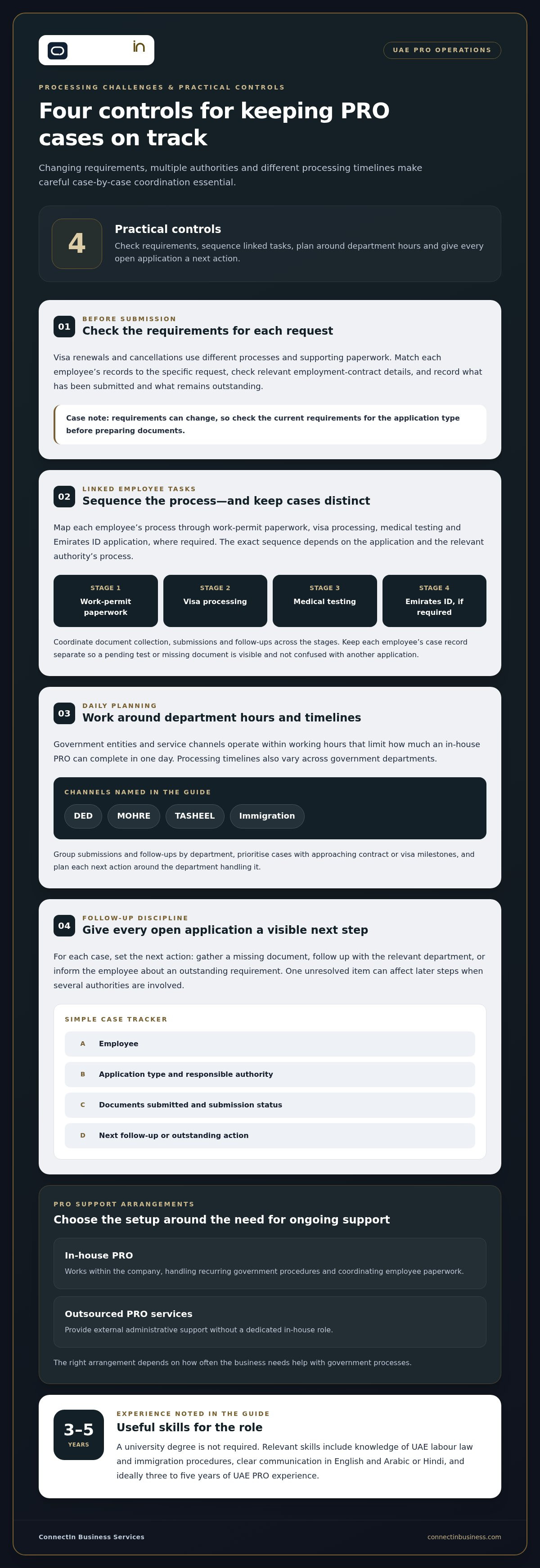
An in-house PRO works within a company, handling recurring government procedures and coordinating employee paperwork. Outsourced PRO services provide external administrative support without a dedicated in-house role. The right arrangement depends on how often your business needs help with government processes.
A PRO officer does not need a university degree for the role. Relevant skills include knowledge of UAE labour law and immigration procedures, clear communication in English and Arabic or Hindi, and ideally three to five years of UAE PRO experience.
- Track requirements before submitting. UAE visa and immigration procedures can change, so check the current requirements for each application type before preparing documents. For example, a visa renewal and a cancellation involve different processes and supporting paperwork. Match each employee’s records to the specific request, including the relevant details in employment contracts. Keep a record of what has been submitted and what remains outstanding. This step helps prevent avoidable rework when an application needs correction.
- Sequence visa, work-permit and Emirates ID tasks. Map the employee’s process from work-permit paperwork through visa processing, medical testing and Emirates ID application, where required. The exact sequence depends on the application and the relevant authority’s process. A PRO coordinates document collection, submission and follow-up across those stages. Keep each employee’s case record distinct, so a pending medical test or missing document is visible rather than confused with another application.
- Plan around department working hours. Government entities and channels, including DED, MOHRE, TASHEEL and Immigration, operate within working hours that limit how much an in-house PRO can complete in one day. Group submissions and follow-ups by department, and prioritise cases with approaching contract or visa milestones. Processing timelines also vary across government departments. A PRO should track each submission’s status and plan the next action around the department handling it, rather than assume every application moves at the same pace.
- Build follow-up into the daily schedule. Set a clear next step for every open application: gather a missing document, follow up with the relevant department, or inform the employee about an outstanding requirement. Visa and work-permit processing may involve several authorities, so one unresolved item can affect later steps. For a team handling multiple cases, maintain a simple tracker with the employee, application type, submission status and next action. This creates a practical view of workload, processing delays and changing requirements.
Immigration and labour department coordination
A Public Relations Officer coordinates between a business and government departments. Organise each case by authority, document type and next action.
-
Coordinate Trade Licences and Labour Approvals
Match each labour approval request to the company’s current trade licence details. A UAE PRO may assist with Department of Economic Development (DED) requirements and labour agreements. Check that the company records and employee information correspond across submissions. If a licence amendment affects the company’s details, address that record before relying on it in related paperwork.
-
Prepare Labour and Work Permit Paperwork
Collect the employee and employer details required for the relevant MOHRE process. A PRO can coordinate work permits, labour contracts and labour cards, while tracking each document’s submission status. Compare names and identifying details across the paperwork before submission. Keep each employee’s documents together so one person’s contract or permit request is not confused with another’s case.
- Route immigration applications through the relevant channel. Depending on the transaction and location, a PRO may deal with GDRFA or ICP and service channels such as Amer. Identify the authority handling the request before submitting documents. Then record the application reference, status and required follow-up, so the business can see which immigration steps remain open.
- Coordinate connected employee procedures as separate but related tasks. Visa processing, work-permit paperwork, residency documents and Emirates ID applications may involve different stages and channels. A PRO helps organise requirements for employees and dependents and coordinates submissions with relevant government bodies. Track each stage so outstanding documents are addressed before the next related action.
- Use a case tracker to coordinate communication between the company, employee and department. Record the application type, responsible authority, documents submitted and next follow-up. For example, track a MOHRE labour-contract matter separately from a GDRFA immigration application, even when both concern one employee. Clear records help identify whether a delay relates to paperwork, a pending step or department processing.
When licence records and labour approvals need coordinated attention, organising trade licence paperwork can be part of the process.
How does a PRO facilitate business operations in the UAE?
A PRO supports business operations by coordinating licensing, renewals, permits and approvals. Use these steps to keep each government transaction organised.
-
Handle Business Licensing and Company Formation
Start by identifying the company’s licensing authority and approved business activity. A PRO in Dubai may process trade licence renewals with the Dubai Department of Economic Development. A PRO can coordinate company registration and licensing paperwork, then organise the issued trade licence and certificate records. Check that the activity and company details match across documents. Keep the licence accessible for related applications and future renewals.
-
Obtain Permits and Regulatory Approvals
List the permits and approvals required for the business activity before starting submissions. A PRO can coordinate applications with relevant government departments and track each response. Requirements depend on the activity and the authority reviewing it. Keep approval records with the company licence and note any conditions attached. This helps distinguish an issued permit from an application still awaiting a decision.
- Set a renewal schedule using the trade licence expiry date as the key reference. A PRO can prepare renewal paperwork, coordinate submission with the relevant licensing department, and track the outcome. Treat this as a government licence cost, not a professional service fee. The activity class is the stated cost factor.
- Act before expiry to reduce the risk of late renewal penalties. Late UAE trade licence renewal may incur fines of AED 500-2,000 per month. A PRO can track the expiry date, identify outstanding documents and follow up with the responsible department. Keep the renewal status visible to the people managing company operations. This gives the business time to address a missing record or pending approval before it disrupts licensing administration.
- Record licence changes and approvals separately. If the company changes its business details or activity, identify the required amendment and coordinate the paperwork with the licensing authority. Keep the current licence, amendment submission and resulting approval together. Avoid using outdated licence details in another application. Clear records also help staff provide the latest licensing information when a government department requests it.
PRO support for mainland and free-zone businesses
Match PRO support to your company’s jurisdiction and recurring government tasks. Mainland and free-zone businesses may use different authorities and procedures.
- Identify whether the company is mainland or free-zone registered. Mainland companies must have a PRO to handle labour, immigration and licensing tasks. A PRO acts as the corporate liaison with government departments, ministries and, where relevant, free zones. Start by listing the authorities connected to your company’s licence and employee processes. This prevents paperwork from being routed through a channel that does not handle the transaction.
- For a mainland business, organise labour, immigration and licensing responsibilities together. These workstreams can involve MOHRE, immigration channels and the relevant licensing department. Assign someone to track each submission, record its status and manage follow-ups. Keep licence-related paperwork distinct from an employee’s permit file while tracking both against the company’s operational needs.
- For a free-zone company, identify the relevant free-zone authority before preparing a submission. A business may not need a full-time PRO, but can still use PRO services for visas and renewals. Map each requirement to the appropriate authority and keep the process separate from mainland procedures. This clarifies which paperwork belongs to the free-zone licence and which concerns employees.
- Decide whether recurring tasks call for dedicated in-house capacity or external support. Outsourced PRO services provide support with government procedures without requiring a dedicated in-house role. A larger firm with frequent visa processing and legal-document requirements may prefer dedicated support. Match the arrangement to your workload and the types of tasks involved.
- Build a jurisdiction-specific schedule for renewals, visas and other submissions. Record the responsible authority, required paperwork, current status and next action for each task. A PRO may also coordinate approvals for office leases and tenancy contracts. Keep those records with relevant corporate documents rather than employee files. This gives managers a practical view of outstanding obligations across mainland or free-zone operations.
A PRO’s role connects a business with government departments, ministries and free zones. Define the responsibility clearly within your business so teams know who coordinates these relationships and where to direct related requests. This keeps the PRO’s work connected to the company’s government-facing administration.
What government documents and transactions does a UAE PRO handle?
Sort each document by its purpose, issuing authority and required transaction. This makes PRO paperwork easier to track from submission through follow-up.
- Separate employee records from company records. Create distinct files for visas, work permits, labour contracts and company licences. A PRO may coordinate government applications for these documents and organise copies by employee or business transaction. For example, keep an employee’s visa paperwork separate from the company’s trade licence renewal documents. Use consistent file names and record each submission’s status so staff can find the correct record quickly.
- Group immigration documents by application. Residency permits, Emirates ID applications and medical-test requirements relate to employee immigration procedures. A PRO helps coordinate these requirements for employees and dependents while tracking which documents belong to each case. Keep a separate record for each person and application to avoid confusing one employee’s pending paperwork with another person’s completed transaction.
- Maintain labour and employment paperwork together. MOHRE processes can include work permits, labour contracts and employee grievances. A PRO coordinates relevant submissions and keeps labour-related documents with the employee’s case record. Before submission, compare names and company details across the contract and supporting paperwork. Clearly record any outstanding action, such as completing a document set or following up on an application.
- Keep corporate licensing records current. Trade licences, permits and related approvals are essential company documents a PRO can help manage. File the current licence separately from earlier versions and retain related amendment or renewal records. If a government department requests company information, staff can identify which licence and supporting documents apply. Structured records also distinguish an issued approval from an application still being processed.
- Organise documents requiring attestation or legalisation. UAE PRO work may include coordinating attestations and legalisations for business documents. Identify the document, its intended use and the transaction it supports before arranging the process. Keep the original and processed records linked in the company’s file system. For documents requiring this handling, arrange document attestation as part of the business’s administrative workflow.
- Track each transaction to its next action. For every file, note the document type, responsible authority, submission status and required follow-up. A visa application, trade licence record and attested document each need distinct tracking. Review open items regularly and direct questions to the relevant department or channel. This helps prevent incomplete records from being treated as finished government transactions.
ConnectIn Business Services: Mainland Company Formation
ConnectIn Business Services supports businesses with PRO and administrative requirements in Dubai and across the UAE. If you’re establishing a mainland business, its Mainland Company Formation service can help organise the setup process. Businesses considering a free-zone structure can also access Free Zone Company Formation.
For an existing company, ConnectIn’s Company License Amendments and Share Transfers services address specific changes to corporate records. These services are relevant when licensing details or ownership arrangements need attention, rather than for routine employee visa processing. Matching the support to the task helps keep company administration focused.
Contact ConnectIn Business Services to discuss the company formation, PRO support or corporate change that fits your business needs.
Turn PRO Knowledge Into Your Next Business Step
Knowing what a PRO officer does in the UAE gives you a practical way to plan for your company’s next stage. Before taking action, identify the matter to address: establishing a mainland or free-zone business, updating an existing trade licence, or coordinating ongoing government paperwork. A clear priority helps you choose support that fits your business rather than treating every administrative task as one broad requirement.
ConnectIn Business Services offers Mainland Company Formation, Free Zone Company Formation, Company License Amendments and PRO Services. These services support businesses at different stages, from setting up a company to changing a licence or coordinating government processes. The right next step depends on the matter your company needs to address.
Contact ConnectIn Business Services to discuss the formation or licence change relevant to your business. A considered next step can help you move forward with greater clarity.
Frequently Asked Questions
What Does a PRO Officer Do Day-to-Day?
A PRO officer organises open government transactions and prioritises those that need attention. A typical workday may begin with reviewing pending submissions, identifying missing employee documents and arranging follow-ups with relevant departments. The officer then updates case records and communicates outstanding actions to colleagues or employees. This workflow helps a business distinguish completed transactions from applications that still need action.
What is PRO in a company?
In a UAE company, a PRO is the person who coordinates administrative dealings with government departments. The role connects internal teams with official procedures and helps organise company and employee paperwork for relevant transactions. For example, a human resources team may rely on a PRO to coordinate an employee’s government documentation while keeping company records aligned with the application.
Does PRO mean professional?
No. In the UAE business context, PRO stands for Public Relations Officer, not “professional.” The title refers to a role involving government-related company administration. Its meaning depends on context, so a job title mentioning a PRO refers to public relations and government procedures, not a general professional qualification.
How important is local knowledge for a PRO in the UAE?
Local knowledge helps a PRO identify which authority or channel handles a particular transaction. UAE processes can involve MOHRE, GDRFA, ICP, Tasheel or Amer, depending on the paperwork. Communication skills also matter: English and Arabic or Hindi are considered ideal for the role. This familiarity helps the officer coordinate with employees and departments using the appropriate process and terminology.
Is PRO full form?
In the UAE, PRO stands for Public Relations Officer. The title describes a role that coordinates government-related paperwork and processes for a business or individual. It does not, by itself, identify a university degree or professional certification. For a company, the practical focus is the officer’s ability to manage administrative procedures and communicate with the authorities involved in each transaction.
What Is PRO Meaning in UAE?
In the UAE, PRO generally means Public Relations Officer, a role associated with government transactions and administrative paperwork. A PRO card is a separate item: it is a government-issued card that allows individuals to process documents. The title and the card are not interchangeable. Understanding the distinction helps businesses describe the role accurately when assigning or discussing government-processing responsibilities.
What does a PRO officer do in the UAE?
A PRO officer coordinates a business’s government-facing administrative work. This can include helping employees and their dependents with residency permits, Emirates ID applications and medical-test requirements. The officer also liaises between the company and government bodies, organising paperwork and tracking progress. The precise tasks depend on the company’s needs, jurisdiction and type of application.
What are the duties of a PRO officer for a UAE company?
A PRO officer helps maintain official company records and coordinate government applications. Duties can include organising visa, trade licence and labour-related documents, coordinating approvals and following up on renewals. The officer may also coordinate document attestation and legalisation. For an effective internal control, record each transaction’s document type, responsible authority and current status.


