

In 2026, a trade license alone no longer guarantees a seat at Dubai’s economic table. With the Federal Tax Authority now enforcing a fixed AED 10,000 penalty for late corporate tax registration, the margin for administrative error has vanished. You likely recognize that the traditional appeal of the UAE market is now balanced by a sophisticated regulatory environment that demands precise tax structuring and economic substance. Selecting between a Mainland entity and a Free Zone is no longer just a matter of cost; it’s a strategic decision that dictates your access to the local market and your eligibility for Small Business Relief on revenues up to AED 3,000,000. Successful business setup in dubai now requires a partner who treats compliance as a foundation for growth rather than a hurdle.
This guide provides the clarity you need to navigate these intricate systems with total confidence. We'll outline a definitive roadmap to securing your trade license while ensuring full adherence to the latest 2026 mandates, including the new VAT supplier verification rules and Electronic Invoicing System requirements. You'll gain a comprehensive understanding of how to manage PRO requirements and documentation to significantly reduce your administrative burden. By the end of this analysis, you'll have a clear strategy to launch your venture with both regulatory precision and long-term operational excellence.
Key Takeaways
- Identify the strategic differences between Mainland and Free Zone jurisdictions to optimize your market reach and 100% foreign ownership rights.
- Navigate the updated 2026 roadmap for business setup in dubai by following a structured approach to trade name reservation and Department of Economy and Tourism approvals.
- Determine the most appropriate trade license category for your operations to ensure full compliance with the latest commercial and industrial standards.
- Recognize the critical role of PRO services in managing document attestation and government liaison to minimize administrative delays and penalties.
- Prepare for the transition to mandatory digital compliance, including the Electronic Invoicing System and UAE Corporate Tax registration requirements.
Navigating the Dubai Business Ecosystem in 2026
Dubai’s commercial sector is undergoing a profound transformation. As we move through 2026, the city has solidified its position as a global nexus for trade and innovation. This evolution is driven by the Dubai Economic Agenda (D33), an ambitious roadmap designed to double the size of the emirate's economy by 2033. For entrepreneurs, this means the economic landscape of Dubai offers unprecedented stability and a clear trajectory for growth. Central to this ecosystem is the Department of Economy and Tourism (DET). The DET acts as the primary regulatory body for all mainland enterprises, ensuring that every business setup in dubai aligns with the city’s high standards of commercial integrity and operational excellence.
Dubai's Economic Agenda (D33) and Your Business
The D33 Agenda is a commitment to future-proofing the economy through diversification and digital integration. By 2026, the focus has intensified on high-growth sectors such as Artificial Intelligence, Green Technology, and advanced Logistics. The government has introduced specific incentives for both SMEs and multinational corporations to anchor their operations in the emirate. These include streamlined licensing pathways and enhanced access to regional markets. If your venture operates within these priority sectors, you're positioned to benefit from a supportive infrastructure designed to accelerate scale. The goal is to integrate Dubai into the top three global economic cities, creating a fertile environment for businesses that prioritize innovation and sustainability.
The Reality of Regulatory Compliance
Entering a market as dynamic as Dubai requires more than just capital. It demands a precise understanding of a regulatory framework that's increasingly aligned with global transparency standards. While the prospect of a "DIY" approach might seem cost-effective initially, it often leads to significant administrative delays or compliance oversights. The UAE has implemented rigorous standards regarding Corporate Tax and Ultimate Beneficial Ownership (UBO) disclosures. These aren't mere formalities; they're essential components of maintaining a valid trade license in a transparent jurisdiction.
Professional corporate service providers act as strategic partners during this process. Expert guidance ensures that your business setup in dubai is compliant from day one, shielding you from the fixed AED 10,000 penalties associated with late tax registrations. These partners handle the intricacies of government documentation and PRO requirements, acting as a bridge between your commercial objectives and the demanding regulatory environment. This proactive approach allows you to focus on your core operations while specialists manage the complexities of adherence and document attestation.
Deciding Between Mainland and Free Zone Jurisdictions
Selecting the appropriate jurisdiction is the most consequential decision in your business setup in dubai. This choice determines your ability to trade locally, your tax structure, and your physical presence requirements. In 2026, the distinction between these two paths has evolved. While Free Zones once held a monopoly on 100% foreign ownership, the Department of Economy and Tourism (DET) now permits full foreign control for more than 1,000 Mainland activities. Your decision should align with your UAE market entry strategy guide, prioritizing either direct local market access or specialized international trade benefits.
Mainland Business Setup: Unlimited Market Access
Establishing a Mainland company provides the freedom to trade across the entire UAE and bid for lucrative government contracts. There are no geographic restrictions on where you can locate your headquarters within the Emirate. A key advantage in 2026 is the Dubai Unified License (DUL), which streamlines administrative interactions through a single digital identity. However, Mainland entities must maintain a physical commercial lease registered through the Ejari system. This requirement ensures compliance with economic substance regulations, though it increases Year 1 costs. These typically range from AED 38,000 to over AED 65,000, depending on the office space and specific commercial activity.
Free Zone Setup: Specialized Hubs for Global Trade
Free Zones function as industry-specific clusters designed to support international operations. Zones like JAFZA and DMCC remain global benchmarks, while newer hubs like Dubai Commercity offer bespoke infrastructure for e-commerce ventures. These jurisdictions provide significant customs duty exemptions and simplified import/export procedures. They're ideal for businesses that don't require direct access to the onshore consumer market. Setup costs are generally lower; Year 1 packages range between AED 18,500 and AED 26,000. These often include "flexi-desk" options that satisfy basic licensing quotas without the need for a large physical footprint.
Under Federal Decree-Law No. 20 of 2025, businesses now have the flexibility to re-domicile between jurisdictions without dissolving their legal entity. This corporate mobility allows your structure to grow alongside your market presence. If you're weighing the benefits of these jurisdictions, our specialists can provide a tailored comparison of Mainland and Free Zone company formation to ensure your venture is positioned for maximum efficiency.
Essential Trade Licenses and Regulatory Requirements
The legal foundation of your business setup in dubai rests on selecting the correct license category. The Department of Economy and Tourism (DET) classifies licenses into four primary pillars: Professional, Commercial, Industrial, and Tourism. Each category carries distinct operational permissions and ownership structures. Professional licenses are tailored for service-based consultants and artisans, while Commercial licenses cater to entities trading goods. Industrial licenses are mandatory for manufacturing, and Tourism licenses govern hospitality and travel services. Accuracy here is paramount, as your license type dictates your corporate tax obligations and your eligibility for specific government incentives.
Beyond the license itself, every new entity is legally mandated to register for Corporate Tax within three months of incorporation. The Federal Tax Authority enforces this statutory window strictly. Failure to register within this timeframe triggers a fixed AED 10,000 administrative penalty. Compliance isn't a one-time event; it's an ongoing requirement that begins the moment your initial approval is granted. Managing these timelines effectively is the difference between a smooth launch and a costly administrative burden.
Selecting the Correct Business Activity
Accuracy in activity selection is vital for long-term operational success. The DET provides an exhaustive list of thousands of activities. While you can typically include up to 10 activities on a single license within the same category, they must be logically compatible. An 'activity mismatch' isn't just a minor clerical error. It's a regulatory risk that often leads to rejected corporate bank account applications or complications during future Trade License Amendments. If your business model pivots or expands, you must update your license immediately to reflect your actual operations and maintain full compliance with UAE standards.
Legal Translation and Document Attestation
The UAE regulatory system operates primarily in Arabic for all official government records. Consequently, all foreign corporate documents, including board resolutions, power of attorney, and educational certificates, must undergo a multi-step authentication process. This begins with legalization in your home country and culminates in attestation by the UAE Ministry of Foreign Affairs. Without these stamps, your documents hold no legal weight in the Emirates.
Once attested, these documents require Certified Legal Translation by accredited Arabic translators to be accepted by the DET. We specialize in streamlining the entire Document Attestation workflow, ensuring that your paperwork meets the exact standards required for a valid trade license. Our PRO Services team handles the liaison between government departments, acting as the bridge that simplifies these complex logistical hurdles. This end-to-end support allows you to focus on your commercial objectives while we handle the precision required for document verification.
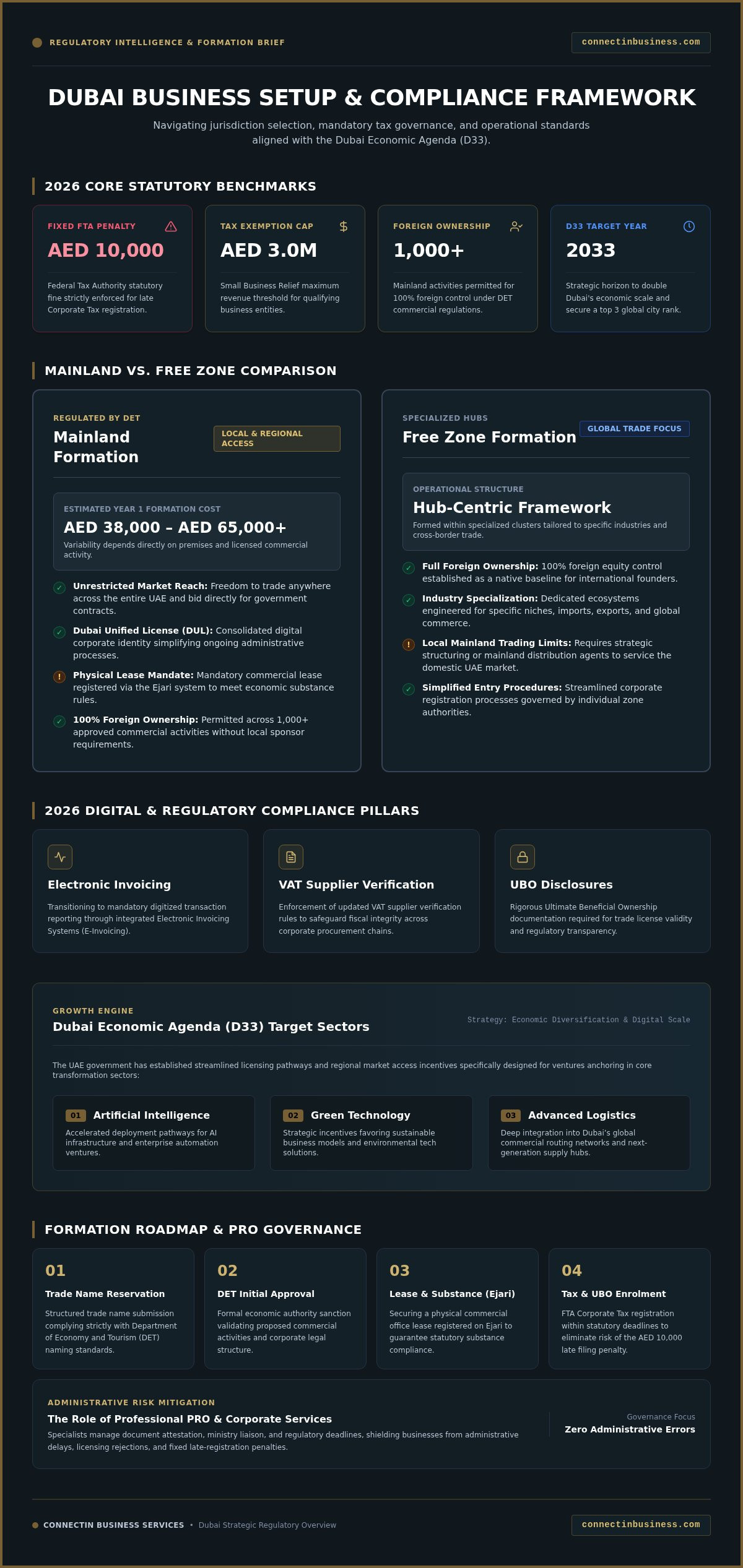
The 2026 Step-by-Step Roadmap to Company Formation
Establishing a corporate presence in the UAE is a methodical process that rewards precision. While digital portals have accelerated the initial stages, the journey from concept to operational status involves specific legal and physical milestones. A successful business setup in dubai follows a structured five-step sequence designed to ensure both regulatory compliance and operational readiness. Each phase requires careful coordination between the Department of Economy and Tourism (DET), the Ministry of Labor, and the Federal Tax Authority.
- Step 1: Finalizing Legal Structure: You must determine if a Limited Liability Company (LLC) or a Sole Establishment best suits your commercial goals.
- Step 2: Initial Approval and Trade Name Reservation: This phase secures the DET’s preliminary consent and ensures your chosen name adheres to UAE naming conventions.
- Step 3: Drafting the Memorandum of Association (MOA): This constitutional document defines the shareholding structure and must be signed before a notary or via the digital portal.
- Step 4: Securing Office Space and Ejari: For Mainland entities, a physical commercial lease is mandatory. The Ejari registration serves as proof of economic substance.
- Step 5: Final License Issuance and Visa Processing: Upon payment of the license fees, the DET issues the trade license, allowing you to begin investor and employee visa applications.
From Initial Approval to Trade License
Securing a trade name is more than a branding exercise; it's a legal requirement. UAE law prohibits names that contain religious references, political affiliations, or offensive language. The name must also accurately reflect your primary business activity. Once reserved, the timeline for license issuance varies. While Free Zone licenses can sometimes be processed within 3 to 5 working days, Mainland licenses typically require 7 to 10 days due to the Ejari registration requirement. During this phase, we also facilitate Share Transfer Services or partner additions if your corporate structure evolves before the final license is issued.
Visas and Workforce Administration
The final phase of business setup in dubai involves securing residency for investors and staff. The 10-year Golden Visa remains a prestigious option for those meeting the AED 2,000,000 investment threshold. Standard investor visas follow a strict path involving a medical fitness test and Emirates ID biometrics. However, the true final hurdle is opening a corporate bank account. Due to stringent AML and UBO regulations, banks typically require 3 to 6 weeks to complete their onboarding process. We provide the documentation support necessary to navigate these institutional requirements efficiently. If you're ready to begin your journey, our team can manage your entire Mainland company formation from initial approval to final visa issuance.
Optimising Operations: The Role of PRO and Corporate Services
Completing your initial business setup in dubai marks the transition from planning to active operations. However, the complexity of the UAE regulatory environment persists long after the trade license is issued. Sustaining a compliant and efficient entity requires a proactive approach to corporate governance. This is where PRO Services become indispensable. They act as the operational backbone, managing the continuous cycle of renewals, labor relations, and regulatory updates that define the Dubai market.
The Value of Outsourced PRO Services
Maintaining an in-house administrative department to handle government liaison is often an unnecessary overhead for growing firms. Outsourcing these functions to a specialized partner ensures that your interactions with the Ministry of Human Resources and Emiratisation (MoHRE) and the General Directorate of Residency and Foreigners Affairs (GDRFA) are handled with precision. In 2026, the stakes for compliance are higher than ever. Mainland employers must reach a cumulative 10% Emiratisation rate by December 31, 2026. Failure to meet these quotas results in significant financial penalties, currently standing at AED 9,000 per month for every unfilled Emirati position.
Beyond recruitment quotas, staying ahead of Wage Protection System (WPS) updates is critical. The UAE authorities utilize automated digital ecosystems to monitor salary disbursements. Any discrepancy can result in immediate blockages of your labor file, preventing you from issuing new visas or renewing existing ones. A dedicated PRO partner monitors these shifts in real-time. This ensures your workforce administration remains uninterrupted while you focus on scaling your commercial operations.
Corporate Governance and Amendments
A successful business is rarely static. As your venture evolves, your legal structure must adapt to reflect your growth. We facilitate Trade License Amendments to accommodate changes in business activities, office locations, or corporate branding. Executing Share Transfer Services is another critical aspect of governance, particularly when bringing in new investors or restructuring ownership. These changes must be legally codified through the Department of Economy and Tourism (DET) to remain valid. Without professional oversight, these amendments can trigger lengthy delays in banking updates or visa renewals.
Compliance also extends to the eventual conclusion of a business lifecycle. Company Liquidation is a formal statutory process that requires meticulous attention to detail to ensure a graceful market exit. This involves cancelling all visas, settling labor liabilities, and obtaining clearances from utility providers and telecommunications authorities. Throughout these phases, Certified Legal Translation ensures that all corporate resolutions and settlement agreements meet the linguistic standards of the UAE government bodies. By integrating these expert services into your long-term strategy, you secure the administrative efficiency necessary for sustained success during and after your business setup in dubai.
Securing Your Commercial Future in Dubai
Success in the world's most dynamic commercial hub requires more than an entrepreneurial vision. It demands a rigorous adherence to an evolving regulatory framework. As we've explored, the distinction between Mainland and Free Zone jurisdictions now hinges on your specific market entry strategy and tax optimization goals. Navigating the 2026 landscape involves mastering the intricacies of Corporate Tax registration, Emiratisation quotas, and the digital transition toward electronic invoicing. These elements are the essential pillars of a resilient enterprise.
Professional guidance acts as your shield against administrative delays and non-compliance penalties. At ConnectIn Business Services, we're specialists in both Mainland and Free Zone formation, providing the end-to-end support necessary to transform complexity into clarity. Our team delivers comprehensive PRO and administrative support, alongside accredited legal translation services, to ensure your documentation meets the highest government standards. We don't just process licenses; we handle the technical burden so you can focus on scaling your brand. Start your Dubai success story with ConnectIn Business Services and launch your venture with total strategic confidence. Your journey toward a successful business setup in dubai begins with a partner who values precision as much as you do.
Frequently Asked Questions
What is the total cost of business setup in Dubai in 2026?
Total costs depend on your chosen jurisdiction and business activity. For a standard Free Zone setup including one investor visa and a flexi-desk, Year 1 costs typically range between AED 18,500 and AED 26,000. Mainland LLC formation requires a physical commercial lease (Ejari), which increases the total Year 1 investment to between AED 38,000 and AED 65,000. These figures account for initial approvals, trade license fees, and mandatory establishment cards.
Can I own 100% of my company in Dubai Mainland?
Yes, foreign nationals can retain 100% direct ownership of their company on the Dubai Mainland for over 1,000 commercial and professional activities. Under the consolidated commercial companies framework administered by the Department of Economy and Tourism (DET), the requirement for a 51% local Emirati shareholder has been removed for most sectors. Strategic industries, such as defense and oil and gas, remain the only exceptions where local partnership is still mandatory.
How long does it take to get a trade license in Dubai?
The timeline for a business setup in dubai depends on the complexity of your chosen structure. Free Zone licenses are often issued within 3 to 5 working days, provided all documentation is complete. Mainland licenses typically require 7 to 10 days, as they involve securing a physical office and registering the lease through the Ejari system. Opening a corporate bank account remains a separate phase, usually taking an additional 3 to 6 weeks.
Is a physical office mandatory for a Dubai business setup?
Physical office requirements differ between jurisdictions. Mainland companies must have a registered commercial tenancy (Ejari) to maintain a valid license. This reflects the UAE's emphasis on economic substance. Conversely, most Free Zones offer flexi-desk or shared workspace options that satisfy licensing quotas for startups and small enterprises. However, businesses aiming for higher visa quotas or specific industrial activities will eventually require dedicated physical premises to meet regulatory standards.
What is the difference between a Trade License and a Professional License?
The primary difference lies in the nature of the business activity. A Commercial License is issued to entities engaged in trading goods, such as wholesale or retail operations. A Professional License is designated for individuals or firms providing services based on specialized skills or intellectual efforts, such as consultancy or engineering. While both allow for 100% foreign ownership, Professional licenses often require a local service agent to facilitate government-related administrative tasks.
How does UAE Corporate Tax affect new business setups?
UAE Corporate Tax is a critical consideration for any business setup in dubai. The standard rate is 0% on taxable net profits up to AED 375,000 and 9% on profits exceeding that threshold. However, under Ministerial Decision No. 131 of 2026, resident businesses with gross annual revenue of AED 3,000,000 or less can elect for Small Business Relief. This grants them a 0% effective tax rate for tax periods ending on or before December 31, 2029.
Do I need a local sponsor for my Dubai company in 2026?
In 2026, a local Emirati sponsor is no longer required for the vast majority of business activities in Dubai. The implementation of 100% foreign ownership laws has made the 51/49 ownership split obsolete for most commercial and professional licenses. You only need a local partner if your business operates in specific strategic sectors, such as telecommunications or military services. For most entrepreneurs, this change has significantly simplified the corporate registration process.
What are PRO services and why does my business need them?
PRO services involve managing all administrative interactions between your business and UAE government departments. These specialists handle visa processing, labor file allocations, and trade license renewals. They also ensure compliance with the Wage Protection System and Emiratisation quotas. Utilizing professional PRO support reduces your administrative burden and shields your company from fixed penalties, such as the AED 10,000 fine for late corporate tax registration or failure to register for VAT.


