

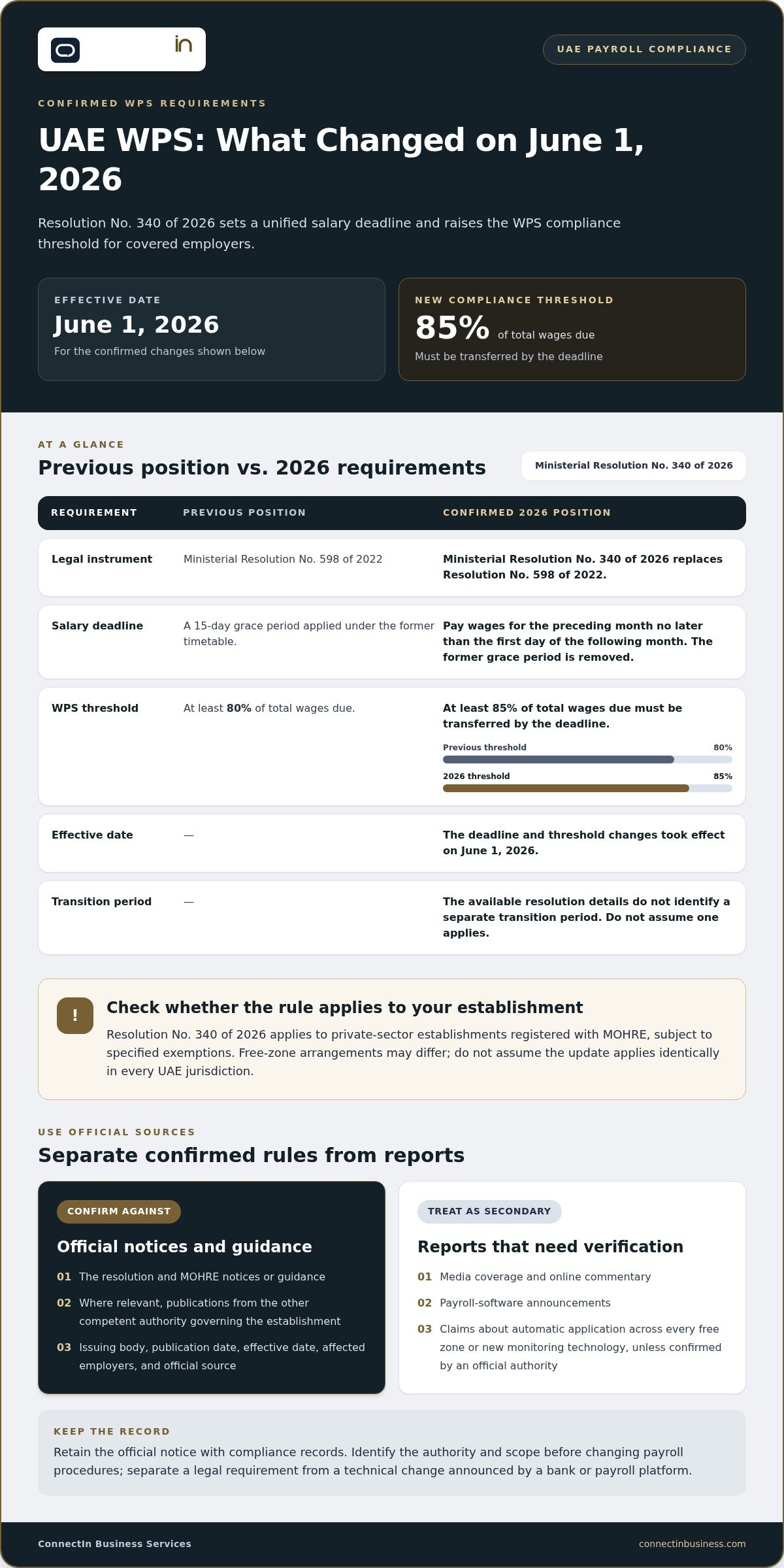
Could a payroll process that met last year’s timetable now expose your business to compliance risk? The uae wage protection system updates that took effect on June 1, 2026, changed key requirements for MOHRE-registered private-sector employers. Ministerial Resolution No. 340 of 2026 sets a unified salary deadline: wages for the previous month must be paid by the first day of the following month. It also raises the WPS compliance threshold to 85% of total wages due.
Conflicting online reports can be difficult to assess, especially when a missed payment or inaccurate salary record can have serious consequences. The new threshold does not permit arbitrary deductions, and the rules do not apply identically in every UAE jurisdiction. Employers need to distinguish confirmed requirements from claims that need verification.
This article explains what the 2026 changes mean, how WPS salary processing works, and which payroll records and internal checks to review. It also outlines how to assess an official notice and identify proportionate next steps, including where organised PRO and administrative support can help maintain sound regulatory processes.
Key Takeaways
- Learn how to distinguish official uae wage protection system updates from reports that may not apply to your business.
- Understand the main steps in WPS salary processing and the roles of relevant UAE authorities and financial institutions.
- Use a practical workflow to assess a notice’s source, scope, and operational impact before changing payroll procedures.
- Review the payroll data, employee details, payment records, and internal responsibilities that support accurate WPS administration.
- See how organised PRO and administrative support can complement your team’s compliance work.
UAE Wage Protection System updates in 2026: what is confirmed?
The UAE Wage Protection System (WPS) is an electronic mechanism for monitoring salary payments made by employers to workers through approved channels. It creates a payment record that helps authorities assess whether wages have been paid in line with applicable requirements.
What is the UAE Wage Protection System?
The WPS monitors and records salary payments to workers through approved payment channels. Ministerial Resolution No. 340 of 2026 applies to private-sector establishments registered with the Ministry of Human Resources and Emiratisation (MOHRE), subject to specified exemptions. Free-zone arrangements may differ, so employers should identify the authority and rules that apply to their establishment before relying on a general update.
WPS monitoring supports oversight of salary payments, but it does not replace an employer’s responsibility to understand the wage obligations that apply to its workforce. Keep payment information accurate and assess official guidance against your establishment’s regulatory status.
Confirmed 2026 timeline
The key dates and changes are:
- 2026, issuance: MOHRE issued Ministerial Resolution No. 340 of 2026, replacing Resolution No. 598 of 2022. The available details identify the year of issuance but not a separate announcement day.
- June 1, 2026, effective date: For MOHRE-registered private-sector companies, wages for the preceding month are due no later than the first day of the following month. The former 15-day grace period was removed.
- June 1, 2026, compliance threshold: An establishment is considered compliant when it transfers at least 85% of total wages due to workers by the deadline. The previous threshold was 80%.
- Transition: The available resolution details do not identify a separate transition period. Employers should not assume one applies.
How to distinguish an official update from a report
For reliable uae wage protection system updates, start with the resolution and MOHRE notices or guidance. Where relevant, review publications from the other competent authority governing the establishment. Record the issuing body, publication date, effective date, affected employers, and official source, then retain the notice with your compliance records.
Media coverage, payroll-software announcements, and online commentary may point to developments worth investigating, but they are secondary sources, not regulations. Treat claims about new monitoring technology or automatic application across every free zone as unverified unless an official authority confirms them. The resolution applies to MOHRE-registered establishments. Separate arrangements in financial free zones such as DIFC and ADGM should not be assumed to change automatically.
How the UAE WPS process works, and where updates can affect it
WPS connects payroll preparation with salary transfers through approved channels and the monitoring of payment information. The precise steps depend on the employer’s arrangements and the applicable authority. For MOHRE-registered private-sector establishments, the current framework requires salary payments through WPS or another MOHRE-approved system, with proof of payment retained.
Which organisations and records are involved?
MOHRE sets and administers WPS requirements for establishments within its jurisdiction and uses payment information to monitor compliance. The Central Bank of the UAE regulates financial institutions, while banks and other participating institutions facilitate salary transfers through approved arrangements. These institutions process payments, but the employer remains responsible for complying with its wage obligations.
The employer is also responsible for accurate payroll information. Depending on the payment arrangement, preparation may include confirming employee and salary details, submitting payment instructions through an approved channel, and checking transfer records. Keep payroll calculations, employee records, payment confirmations, and documentation of exceptions or corrections together. Reconcile the prepared amounts against the amounts actually transferred, and resolve discrepancies promptly.
Where an update may change an employer’s workflow
A regulatory update can change an obligation, such as a payment deadline, the information an employer must provide, or the evidence it must retain. A bank or payroll-platform notice may instead describe a technical or service change, such as a different submission format. That can affect internal steps without changing the underlying legal requirement. Confirm what kind of change the notice describes before revising a policy or payroll control.
Illustrative example: If an official notice changes a submission deadline, payroll teams may need to move approval and funding cut-offs earlier so the transfer can be completed on time. If a financial institution changes how payment instructions are uploaded, the team may need to adjust file preparation while separately checking whether the legal deadline has changed. Record these as different impacts.
When assessing uae wage protection system updates, identify the issuing authority, the employers and workers in scope, and the effective date. Then map the confirmed change to the relevant payroll step: data preparation, approval, submission, transfer, reconciliation, or recordkeeping. Do not treat a software feature announcement as a regulatory amendment unless official authority guidance supports that interpretation.
Clear administrative ownership helps keep these checks consistent. Employers reviewing their wider UAE compliance processes can also explore PRO and administrative support.
What WPS developments could mean for UAE employers
A WPS development can affect a legal obligation, an internal payroll process, or both. The right response depends on what the official notice changes and whether the employer falls within its scope. For MOHRE-registered private-sector establishments, Ministerial Resolution No. 340 of 2026 took effect on June 1, 2026, replacing Resolution No. 598 of 2022 and setting a new wage-payment deadline and compliance threshold.
Regulatory change versus payroll-process change
A regulatory change alters an obligation; a process change alters how an employer or service provider carries out a task. Check the issuing body, the wording of the notice, its publication and effective dates, and the employers it covers. A software announcement may describe a new feature or file format, but it does not by itself establish a new legal requirement.
Comparison of confirmed regulatory changes and operational developments
- Confirmed regulation: Resolution No. 340 of 2026 took effect on June 1, 2026. For MOHRE-registered private-sector establishments, wages for the preceding month are due by the first day of the following month, and the WPS compliance threshold is 85% of total wages due. Payroll teams should review payment timing and reconciliation controls.
- Operational or technology development: A bank, exchange house, or payroll platform may announce changes to its submission process or tools. Treat these as service or workflow information unless an official authority notice also changes an employer’s obligation. Administrators can assess whether the change requires adjustments to file preparation, approvals, or staff instructions.
In short, an official regulation changes what an in-scope employer must do and when. A provider’s process update may change how a payment is prepared or submitted without changing the underlying legal duty.
Which employer teams may need to respond?
Start by confirming applicability. Resolution No. 340 applies to establishments registered with MOHRE. Employers operating in free zones should check the rules and authority governing their establishment rather than assume the MOHRE framework applies identically. Financial free zones such as DIFC and ADGM have separate regimes.
Once the scope is clear, assign review tasks to the relevant people. Payroll can check salary calculations, payment files, deadlines, and transfer confirmations. HR can verify that employee details and salary information are current. Finance can coordinate funding and payment approvals. Business administrators can retain official notices, document the applicability assessment, and track required process changes.
These checks help teams respond proportionately. A notice that changes a deadline may call for revised internal cut-offs; a platform change may require a technical adjustment instead. Keep the source and decision record with the payroll documentation so the reason for each change is clear. Reviewing uae wage protection system updates this way helps avoid treating every reported development as a new compliance obligation.
A practical 2026 checklist for reviewing UAE WPS updates
When you find a reported WPS update, locate the original notice from the issuing authority before changing payroll procedures. This helps prevent a news summary, software announcement, or online discussion from being mistaken for a binding requirement. Use this workflow to assess the update and document a proportionate response.
Verify the source, scope, and effective date
- Locate the original notice. Search the relevant authority’s official publications, such as MOHRE guidance for establishments under its jurisdiction. Save the notice or its official reference instead of relying only on a summary.
- Record the key details. Note the issuing authority, publication date, effective date, affected employers and workers, and any stated transition arrangements. If the notice does not make a deadline or scope clear, record that as unresolved rather than making an assumption.
- Assess whether it applies. Compare the notice’s scope with your establishment’s registration and applicable regulatory arrangements. Rules may differ across UAE jurisdictions, so do not apply a MOHRE notice universally without checking its stated coverage.
- Separate confirmed requirements from reports. Identify whether the notice changes a legal obligation, explains a procedure, or describes a service or technology change. Keep secondary reporting as context, not as the basis for a compliance decision.
Turn confirmed changes into documented actions
- Review relevant payroll information. Check salary data, employee details, payment instructions, transfer confirmations, and records of corrections or exceptions. Focus on records connected to the update rather than changing unrelated processes.
- Confirm dates and responsibilities. Use current official instructions to verify deadlines and effective dates. Assign an owner and completion date to each necessary action across payroll, HR, finance, or business administration.
- Record the decision and follow-up. Document the source reviewed, applicability assessment, action taken, and any outstanding questions. Retain supporting records in line with applicable requirements, and refer unresolved scope or interpretation issues for an appropriately qualified compliance review.
- Update procedures when warranted. If official guidance identifies a material change to a payment or reporting process, revise the relevant internal steps and communicate responsibilities to the staff involved.
This documented approach makes uae wage protection system updates easier to assess consistently and helps teams distinguish an actual obligation from an operational adjustment. For help coordinating UAE administrative and compliance processes, explore PRO and administrative support.
Managing WPS administration with reliable UAE business support
Base WPS decisions on current official guidance and the circumstances of your establishment. A report may draw attention to a development, but the employer still needs to identify the relevant authority, confirm whether the change applies, and decide what action is required. A consistent administrative routine makes that assessment easier to manage.
Integrating WPS monitoring into business administration
Set a regular process for reviewing notices from the relevant UAE authority, recording the source and effective date, and directing each notice to a responsible person. If an update affects payroll administration, document the decision, assign follow-up, and keep the supporting notice with related company records. This creates a clear trail from published guidance to internal action.
WPS monitoring can sit alongside other administrative checks, such as maintaining current company and employee information and tracking regulatory correspondence. The aim is not to treat every announcement as a new obligation. It is to assess relevant changes, clarify responsibilities, and organise records. The employer remains responsible for payroll decisions and wage-payment obligations.
When a business may benefit from administrative support
Administrative coordination can help when a business is managing several regulatory obligations, updating company records, or adapting to operational changes. Internal teams may need to coordinate notices, documentation, approvals, and follow-up across different responsibilities. Organised support can structure those administrative tasks while the employer retains control of payroll and payment decisions.
ConnectIn Business Services supports UAE companies with PRO and administrative services, alongside corporate compliance support. This can complement an employer’s internal processes by helping organise regulatory monitoring and administrative follow-through. It does not replace the employer’s responsibility to verify applicable WPS requirements, maintain accurate payroll information, or ensure salary payments are handled appropriately.
Sound administration depends on clear ownership and reliable records. Employers that want support with related UAE business administration can explore ConnectIn’s PRO and administrative support.
Make WPS oversight part of your business routine
Managing uae wage protection system updates starts with evidence, not headlines. Confirm changes against current official guidance, including the issuing authority, effective date, and businesses in scope. Then assess what the verified requirement means for your payroll process.
Keep salary and employee information accurate, retain payment records, and assign clear ownership for reviewing notices and following up on relevant actions. These controls help your team distinguish regulatory changes from adjustments to a bank or payroll platform, while keeping decisions grounded in your establishment’s circumstances.
WPS administration is part of the wider work of operating a business in the UAE. ConnectIn is a Dubai-based business-services firm offering PRO and administrative services, alongside corporate compliance support. This support can complement internal responsibilities by helping organise regulatory monitoring and administrative follow-through.
Explore ConnectIn’s PRO and administrative support to support your wider UAE business administration. With reliable sources, clear records, and defined responsibilities, your team can approach WPS changes with greater confidence.
Frequently Asked Questions
What are the latest UAE Wage Protection System updates in 2026?
Ministerial Resolution No. 340 of 2026 took effect on June 1, 2026, replacing Resolution No. 598 of 2022. For MOHRE-registered private-sector establishments, salaries for the preceding month are due by the first day of the following month, and the establishment compliance threshold is 85% of total wages due. Under this framework, the former 15-day grace period and 30-day exemption for new employees no longer apply.
Who needs to comply with the UAE Wage Protection System?
WPS requirements under Resolution No. 340 apply to private-sector establishments registered with MOHRE, subject to the framework’s specified exemptions. These include certain workers with active legal disputes, on unpaid leave, absconding, or holding short-term work permits of under three months. Employers should check their registration and applicable rules. Free zones may have distinct arrangements, while financial free zones such as DIFC and ADGM operate under separate regimes.
How can an employer check whether a WPS update is official?
Locate the original notice or guidance published by MOHRE or the competent authority responsible for the establishment. Record the issuing body, publication and effective dates, affected employers or workers, and any transition details. A news article or online summary can point to a development, but it is secondary. Confirm the underlying official publication before changing payroll procedures, and document any questions that remain unresolved.
Can a payroll software update change an employer's WPS obligations?
A software update does not, by itself, change an employer’s legal WPS obligations. It may alter a technical step, such as preparing or submitting payment information, so payroll staff should assess its operational impact separately. Check whether an official authority notice also changes a deadline, reporting requirement, or other obligation. Keep a record of the source and distinguish required compliance action from platform or service adjustments.
What happens if a UAE employer does not follow WPS requirements?
Non-compliance can trigger staged MOHRE enforcement under the 2026 framework. The stated escalation includes alerts from day two, suspension of new work permits from day five, and administrative fines from day 11. Further measures may apply in specified cases, including repeat violations or larger establishments. Consequences depend on the circumstances and applicable rules, so employers should consult current official guidance rather than assume every case follows an identical sequence.
How often should employers review UAE WPS requirements?
Review requirements whenever an official notice is issued, the establishment’s regulatory status changes, or a payroll process is materially updated. It is also prudent to check payment data, employee details, approvals, and transfer records as part of the regular payroll cycle. A software announcement is not automatically a regulatory change. For uae wage protection system updates, keep a dated log of official sources, scope assessments, and assigned follow-up.


