

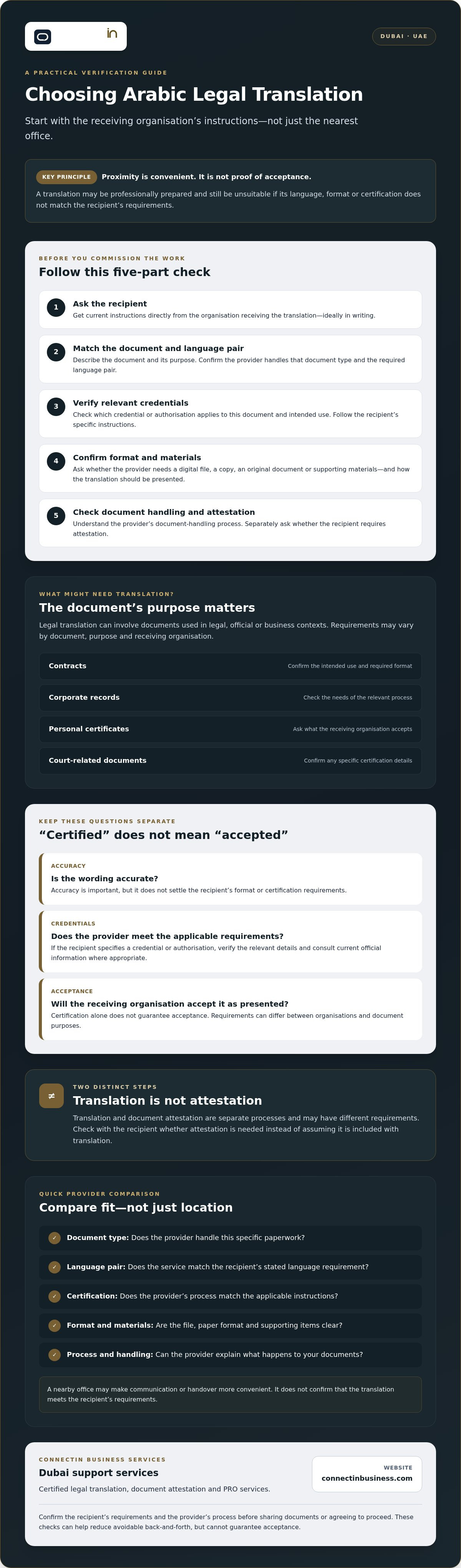
The nearest translation office may not be the right fit for your document. If you’re searching for arabic legal translation near me in Dubai, start by matching the provider’s service and document format to the requirements of the organisation receiving the translation. Proximity can make communication or document handover more convenient, but it doesn’t confirm that the translation will meet those requirements.
When a personal or business matter depends on accurate paperwork, a clear process helps. Checking the recipient’s instructions and the provider’s scope can help you compare options, prepare the right materials and reduce avoidable back-and-forth. These checks can’t guarantee acceptance, since requirements depend on the receiving organisation.
This guide explains what to verify before commissioning Arabic legal translation, including the document type, language pair, certification requirements, file format and document-handling process. It also explains why translation and document attestation are separate steps that may have different requirements. ConnectIn Business Services provides certified legal translation in Dubai, alongside document attestation and PRO services. Confirm the recipient’s requirements and the provider’s process before sharing documents or agreeing to proceed.
Key Takeaways
- When searching for arabic legal translation near me, compare providers by document type, language pair and service scope, not just location.
- Check which credentials or authorisation apply to your document and intended recipient. Certification alone doesn’t guarantee acceptance.
- Before submitting paperwork, confirm whether the provider needs a digital file, copy, original document or supporting materials.
- Ask how the provider handles your documents and explains its process. Check separately whether the recipient requires attestation.
Need Arabic Legal Translation Near Me in Dubai? Start with the Document and Its Recipient
Searching for arabic legal translation near me in Dubai may be prompted by a deadline or a document you need to submit. A nearby provider can be convenient, but first find out what the receiving organisation requires. Even an accurate, professionally prepared translation may be unsuitable if its language, format or certification doesn’t match the recipient’s instructions.
Legal translation involves documents used in legal, official or business contexts. “Certified” describes a translation prepared under an applicable certification process. It doesn’t mean every organisation will accept every certified translation. For a general explanation of the term, see this overview of certified translation. Confirm the requirements for your document and intended use before commissioning the work.
Which documents may need Arabic legal translation in Dubai?
Examples may include contracts, corporate records, personal certificates and court-related documents. A company preparing paperwork for an administrative process may have different language and format needs from an individual submitting a certificate to an organisation. The document’s purpose matters as much as its category. Describe the document and its intended use to the provider, then confirm that the provider handles that type of document and the required language pair.
Requirements can vary with the document, its purpose and the organisation receiving it. Experience with one type of paperwork doesn’t automatically mean a provider is suitable for another. Ask which source files, copies, originals or supporting materials are needed, and whether the provider’s service covers your specific request.
Why does the receiving organisation matter?
A government department, court, company or private organisation may set its own submission instructions. These may specify the target language, accepted format, certification details or whether a separate attestation step is required. Translation and document attestation are distinct processes, so check the requirements for each instead of assuming one includes the other.
Request current instructions directly from the intended recipient, ideally in writing. Check whether it specifies a particular certification or authorisation, how the translation should be presented and which supporting documents must accompany it. Share those instructions with the translation provider before agreeing to proceed. This helps you compare suitable options in Dubai and reduces the risk of commissioning work that doesn’t meet the recipient’s stated requirements.
What to Verify About Certified Arabic Legal Translation in the UAE
When arranging certified Arabic translation, consider three separate questions: Is the wording accurate? Does the translator or provider have the credentials required for this work? Will the receiving organisation accept the translation in the form provided? A positive answer to one doesn’t settle the others. A correctly translated document may still be returned if its certification, language or presentation doesn’t meet the recipient’s instructions.
Before choosing a provider after searching for arabic legal translation near me, confirm which credentials or authorisation apply to your document and its intended use. If the recipient says the translator must be certified by the UAE Ministry of Justice, consult the Ministry’s current information to understand how to verify the relevant details. Don’t assume one credential or process applies to every document or recipient.
Does every UAE authority require the same translation format?
Don’t assume there is one format for every submission. Requirements may differ by organisation and document purpose. Confirm the accepted language, file or paper format, certification details and any supporting documents directly with the recipient. If an instruction is unclear, ask for clarification before commissioning the translation. This is particularly useful when the document is for a specific administrative or business process in Dubai.
Keep the recipient’s instructions available when discussing the work with a provider. Ask whether the provider’s service matches those requirements and clarify anything that remains uncertain. Acceptance is the recipient’s decision, not something a provider’s certification alone can guarantee.
Is translation the same as attestation or notarisation?
No. Translation converts a document’s content from one language to another. Attestation is a separate administrative step that may be required to support a document’s use. Notarisation is distinct as well. These processes aren’t interchangeable, and you shouldn’t assume a translation service includes them.
Ask the recipient whether your document needs attestation or another additional step. If more than one process applies, confirm the required sequence. ConnectIn Business Services lists certified legal translation and document attestation among its services, but it doesn’t offer notary services. You can review its certified legal translation support and confirm whether the document type, language pair and submission requirements match your needs.
Takeaway: Check the recipient’s current requirements before submitting documents. Verify the required credentials, language and format, along with any separate attestation or notarisation step that applies to your specific use.
How to Compare Arabic Legal Translation Providers Near You in Dubai
A search for arabic legal translation near me can bring up several convenient options, but location alone doesn’t show whether a provider is suitable. Compare how clearly each provider addresses your recipient’s instructions, handles your document type and language pair, and explains the work before you share sensitive files.
| Comparison area | What to verify |
|---|---|
| Scope | Does the provider handle your document type, purpose and required language pair? |
| Relevant experience | Can they explain their experience with similar documents without making unsupported claims about acceptance? |
| Certification | What certification or authorisation applies, and does it match the recipient’s instructions? |
| Process | What files or originals are needed? How are formatting, revisions and document return handled? |
| Communication | Will the provider confirm the scope, requirements and outstanding questions in writing? |
Questions to ask before sharing legal documents
Begin with practical questions: “Do you handle this document type and language pair?” and “What certification will the completed translation carry?” Share the receiving organisation’s instructions and ask the provider to explain whether its process aligns with them. Since the recipient decides whether to accept the document, don’t rely on a general assurance that a translation suits every use.
Before sending personal, corporate or court-related records, ask how you should share them, who can access them, how they’re stored and what happens to copies when the work is complete. Request details of the provider’s confidentiality process. Clear answers help you assess both its translation capability and its document handling.
How to assess a quote and service scope
Compare the written scope, not just the provider’s location or headline price. Confirm how pages or words are counted, whether formatting is included, how revisions are handled and whether additional administrative steps fall outside the quoted work. If attestation may be relevant, check the recipient’s instructions and review the UAE Ministry of Foreign Affairs’ document attestation requirements. Translation and attestation are separate processes.
ConnectIn Business Services lists certified legal translation in Dubai. Once you’ve confirmed the recipient’s requirements and your document’s scope, you can Discuss certified legal translation support with ConnectIn and verify the required files, language pair and document-handling process directly.
How to Prepare Documents for Arabic Legal Translation in Dubai
Prepare the submission before translation begins. Confirm the recipient’s instructions, gather complete source documents and agree with the provider on the files or supporting materials needed. This can reduce avoidable clarification and gives you a clear basis for reviewing the translation before submission.
What information should you confirm before requesting a translation?
First, note the document’s purpose, intended recipient, required language and submission format. Then ask the provider what it currently needs, such as digital files, copies, originals or supporting documents. Requirements can vary, so don’t assume a scan will be sufficient or that you must submit an original.
Prepare a clear, complete copy of every page, including stamps, signatures, seals and attachments. Share any recipient instructions about how the translation should be presented. Before work starts, check the spelling of personal names and company details against source records. For corporate documents, check that company names, registration details and reference numbers are consistent. For personal documents, verify names and dates against the original and any relevant records.
Ask whether attestation is separately required for your document and intended use. It isn’t the same as translation, and you should confirm whether it is needed rather than assume. If you’re comparing options after searching for arabic legal translation near me, give each provider the same document description and recipient instructions. Their responses will be easier to compare.
What should you check when you receive the translation?
Review the translation alongside the source before submitting it. Check key details carefully:
- Names, company details and dates
- Figures, amounts, identifiers and reference numbers
- Headings, page order, tables, stamps and other visible formatting
- The certification statement and any accompanying material included in the agreed scope
Reviewing the translation doesn’t replace professional translation, but it can help you spot apparent discrepancies. If a name is transliterated differently from an established record, or a figure or reference appears inconsistent, raise it with the provider before submission. Don’t edit the translated document yourself. Request clarification or correction through the agreed revision process.
Keep the recipient’s instructions and the provider’s written scope with your records. If you need help preparing a document for translation, discuss certified legal translation support with ConnectIn and confirm the current document requirements directly before sending files.
Arrange Certified Arabic Legal Translation Support with ConnectIn in Dubai
Choosing a provider is only one part of preparing a document for official or business use. Before proceeding, confirm what the recipient requires, whether the provider’s service covers your document and language pair, and how your files will be handled. These checks help you make an informed choice when searching for arabic legal translation near me, without assuming that any translation will automatically be accepted.
ConnectIn Business Services provides certified legal translation in Dubai and document attestation. These are distinct services, and whether you need one or both depends on your document and the receiving organisation’s instructions. ConnectIn does not provide notary services or direct court representation. Check any separate requirements with the relevant recipient before deciding how to proceed.
What to share when contacting ConnectIn
To discuss the scope, describe the document category, language direction and intended use. For example, say whether it is a corporate record or personal certificate, identify the organisation that will receive it, and mention any instructions it has provided about certification or format. If you’re working toward a deadline, mention it so the expected timing can be discussed. Confirm timing directly rather than assuming a turnaround.
Before sending sensitive documents, confirm the appropriate submission method and how the files will be handled. Ask what format is required, whether copies or originals are needed and whether to include supporting materials. You can also check the available language pair and relevant document-handling procedures before sharing personal or business records.
What happens after you make an enquiry?
Use the initial discussion to clarify the scope of the requested service and the requirements that apply to your document. Share the recipient’s instructions, then confirm what materials ConnectIn needs and which details still need checking. If attestation may also be necessary, ask about that service separately rather than treating it as part of translation.
The organisation receiving your documents decides whether to accept them, based on its applicable requirements. A provider can explain its scope and process, but shouldn’t promise that a particular translation will be accepted. For a direct discussion about your document type, language direction and intended recipient, Enquire about certified legal translation in Dubai.
Make Your Next Translation Step with Confidence
Choosing a provider for arabic legal translation near me starts with your document’s intended use, not just the provider’s location. Confirm the recipient’s current requirements, check that the provider’s scope and credentials fit your document, and agree on file handling before sharing sensitive records. These steps support an informed choice, though acceptance always rests with the organisation receiving the translation.
ConnectIn serves business clients in Dubai and lists certified legal translation among its services. Document attestation and PRO services are also available, but attestation is a separate process and may not be required for every document. Discuss your document type, language direction and recipient instructions to clarify the scope before proceeding.
Enquire about certified legal translation support in Dubai and confirm the practical requirements for your document directly with ConnectIn. Establishing these details at the outset can make your next step clearer.
Frequently Asked Questions
Is certified Arabic legal translation required for documents submitted in Dubai?
Not in every case. Requirements depend on the document and the organisation receiving it. Before commissioning a translation, ask the recipient which language, certification, format and supporting documents it accepts, and whether any additional steps apply. A provider’s certification alone doesn’t guarantee acceptance. Explain the document’s intended use to the provider and confirm the recipient’s current instructions, particularly for an official or business process in Dubai.
Can I use any Arabic translator for a legal document in the UAE?
Not necessarily. Legal-document translation may require more than general Arabic language ability, especially when the document is going to an official or business recipient. Check the translator’s relevant experience, what certification the service provides and whether the recipient accepts it for your specific purpose. Requirements can vary, so don’t assume one credential applies universally. Confirm the process and document-handling arrangements before sharing sensitive personal or business records.
How much does Arabic legal translation cost in Dubai?
Fees depend on factors such as the document, language direction, length and formatting, as well as any separately required service. Ask for a written scope that explains what the quote covers, how pages or words are counted, whether revisions are included and which additional steps may cost extra. Attestation isn’t automatically part of translation. Compare the full service scope and process rather than choosing by location or headline price alone.
What documents can a certified legal translation provider translate?
Depending on the provider’s scope, examples may include contracts, corporate records, certificates and court-related documents. Don’t assume every provider handles every document category or language pair. Before sending files, describe the exact document and language direction, then confirm that the provider can take on the work. If an authority or other organisation will receive it, check its current submission requirements too, including any specified certification, format or supporting documents.
What happens if an authority rejects my translated document?
Ask the receiving authority to identify the specific issue before requesting changes. The concern might involve the format, certification, supporting documents or another condition, so don’t assume the translation itself is the problem. Share the recipient’s feedback with the provider and agree on the appropriate next step. Confirming current requirements before ordering can help avoid preventable issues. A revision may address an identified problem, but it can’t guarantee acceptance.
Do I need document attestation as well as Arabic legal translation?
Not necessarily. Translation and attestation are separate administrative services, and one doesn’t automatically include the other. Whether attestation is needed depends on the document, its origin and the intended recipient’s current instructions. Confirm each requirement before submitting your paperwork. ConnectIn Business Services lists both certified legal translation and document attestation among its services. Ask about the scope relevant to your document instead of assuming both services are required or bundled together.
How do I choose an Arabic legal translation service near me in Dubai?
Compare providers by relevant document experience, language direction, certification details, confidentiality practices, written scope and clarity of communication, not location alone. Ask whether the provider handles your document type, and confirm acceptance requirements with the intended recipient. Clarify the quote, revision process and any separate attestation needs before proceeding. ConnectIn Business Services provides certified legal translation in Dubai. Confirm its scope and the recipient’s requirements, since acceptance isn’t guaranteed.


