

Could a correctly translated document still be rejected because it doesn’t meet the receiving authority’s requirements? A search for legal translation Dubai services may surface many options, but language expertise alone won’t tell you whether the finished document is suitable for your application or transaction.
It’s understandable to want a clear answer before placing an order. Document translation, certification and attestation serve different purposes, and the requirements can vary depending on where you’ll submit the paperwork. Confirming those details first can help you avoid preventable delays and the cost of correcting or reordering documents.
This guide explains what to check before commissioning legal translation in Dubai, including the intended use, required language, certification process and any additional document procedures. You’ll also learn what to confirm with the receiving authority and translation provider before work begins. With the right questions, you can choose a service that fits your document and prepare a more complete submission.
Key Takeaways
- For legal translation dubai, start with the receiving authority’s requirements and the document’s intended use, not language alone.
- Clarify whether your process requires translation, certification, attestation, or more than one document procedure.
- Compare providers on credentials, relevant document experience, service scope, communication, and delivery details before choosing.
- Prepare complete, legible scans and confirm which supporting documents the translator needs to review.
- ConnectIn Business Services offers certified legal translation, document attestation, and PRO support; confirm your requirements and the next steps before proceeding.
Legal Translation in Dubai: Scope and When You Need It
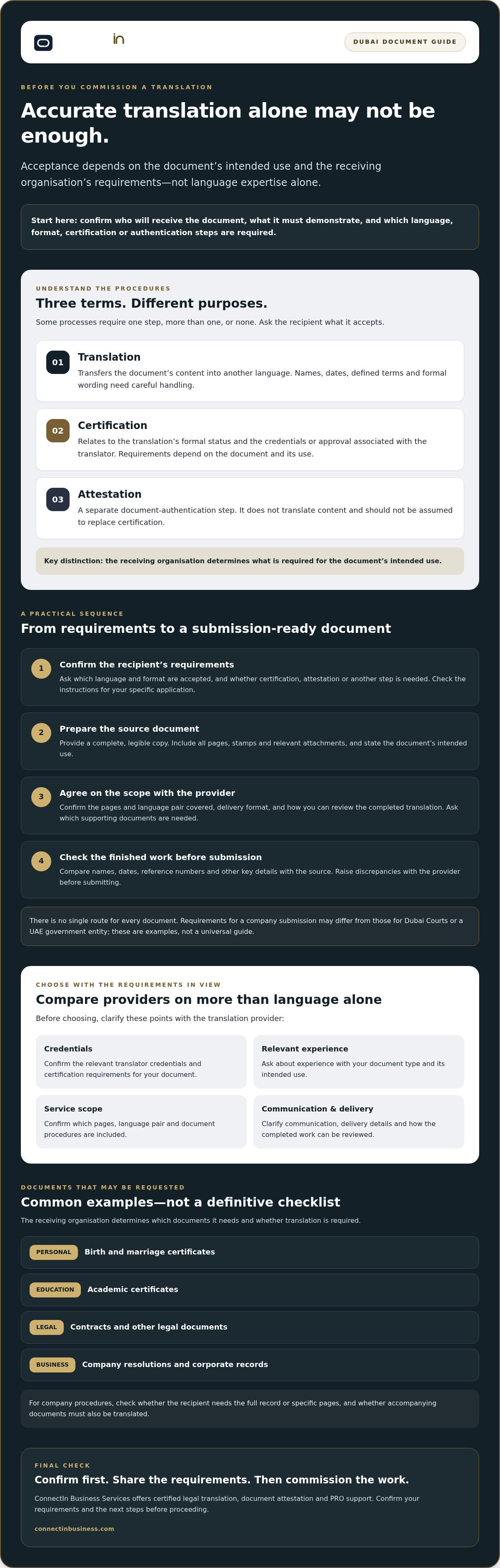
A translation may be accurate and still be unsuitable for your application if it doesn’t match the document’s intended use or the recipient’s requirements. Before ordering legal translation Dubai services, identify who will receive the document and what they need it to demonstrate. That helps clarify the required language, format and whether certification or a separate document procedure is also needed.
Legal translation is the translation of legal or official documents for a specified purpose. It requires careful handling of names, dates, defined terms and formal wording, since even small inconsistencies can complicate review. The right service depends not only on the source and target languages, but also on the type of document and where you plan to submit it.
Which documents commonly require legal translation in Dubai?
Requirements vary by process, but requests may involve personal, educational or business records. Examples include:
- Birth and marriage certificates, and academic certificates
- Contracts and other legal documents
- Company resolutions and corporate records
This is not a definitive checklist. The receiving organisation determines which documents it needs and whether a translation is required, so confirm its instructions before commissioning work. If a document will support a company procedure, check whether the recipient needs the full record or specific pages, and whether accompanying documents must also be translated.
Legal translation, certification, and attestation: what is the difference?
Translation transfers the document’s content into another language. Certification relates to the translation’s formal status and the credentials or approval associated with the translator. In the UAE, requirements for a certified translation can depend on the document and its use. For background on the local framework, see this overview of sworn or certified translation, then verify the applicable requirements with the recipient and provider.
Attestation is a separate document-authentication step. It does not translate the content, and it should not be assumed to replace certification. Some procedures may require translation, attestation, or both, while others may not require either step. Ask the receiving organisation to specify what it accepts, including any required language, certification status and authentication steps.
In short, the receiving organisation determines the acceptance requirements for the document’s intended use. Confirm those requirements before placing an order, and share them with the translation provider so the requested work can be scoped correctly.
How Legal Translation and Document Procedures Work in Dubai
A clear process starts with the organisation that will receive your document, because translation and submission requirements can differ by document type, purpose and recipient. Before requesting legal translation in Dubai, ask the recipient which language, format and certification or attestation steps it requires.
There is no single route that applies to every document. A translation for a company submission may have different requirements from one intended for Dubai Courts or a UAE government entity. Treat those names as examples, not as a universal guide. Check the current instructions for your specific application directly with the relevant authority or organisation.
A practical sequence for commissioning a legal translation
Once you understand the recipient’s instructions, use a simple sequence to reduce uncertainty and avoid unnecessary follow-up:
- Confirm the requirements: Ask which language and format are accepted, and whether certification, attestation or another step is needed.
- Prepare the source document: Provide a complete, legible copy and state its intended use. Check that all pages, stamps and relevant attachments are included.
- Agree on the scope: Confirm with the provider which pages and language pair are covered, what delivery format is available, and how the completed translation can be reviewed.
- Check the finished work: Compare names, dates, reference numbers and other key details with the source. Raise any discrepancy with the provider before submitting it.
Requirements for translator credentials and certification should also be confirmed for the document in question. The UAE Ministry of Justice provides information on the Federal Decree-Law regulating the translation profession. This is a useful reference for understanding the professional framework, but it does not replace instructions from the organisation receiving your document.
Why the receiving authority’s instructions matter
Different recipients may ask for different formats or procedural steps, even when the underlying document is similar. Dubai Courts, ministries and other organisations are examples of recipients whose current requirements should be checked directly. Don’t assume that a translation accepted for one purpose will meet the requirements of another.
Keep the recipient’s instructions with your enquiry so the provider can clarify the requested scope. If the process involves both translation and document attestation, confirm each step separately and establish which should happen first. ConnectIn Business Services offers certified legal translation and document attestation; you can enquire about translation support with the requirements you’ve gathered. Acceptance remains subject to the receiving organisation’s rules.
How to Compare Legal Translation Services in Dubai
Choosing a provider is not just a matter of comparing quotes. For legal translation Dubai, assess whether the provider understands your document, can explain the requested certification scope, and communicates clearly about what is included. A low quote offers little value if key requirements, corrections or delivery arrangements remain uncertain.
Use the same questions for each provider, then compare their answers against the receiving organisation’s instructions. For credential-related information, consult the UAE Ministry of Justice and confirm the applicable requirements for your document and intended use.
Questions to ask a legal translation provider before ordering
Ask which language pairs and document categories the provider handles, and whether your document type is within its experience. Clarify what certification is included and whether attestation or other procedures require a separate arrangement. If source text is unclear, a page is missing or a stamp cannot be read, ask how the provider will flag it before proceeding.
How to assess scope, accuracy, and communication
Compare providers using a written scope, not a headline quote alone. Look for clear answers on document handling, review, corrections, formatting and delivery. Ask how names, dates, reference numbers and visible stamps will be checked against the source, and how the provider protects document confidentiality. Also confirm the delivery format and what happens if you identify an error or need a correction.
| Comparison point | What to confirm |
|---|---|
| Credentials | Which credentials or certification apply to the document and intended use? |
| Relevant experience | Has the provider handled this type of personal, legal or corporate record? |
| Scope | Which pages, language pair and certification steps are included? |
| Communication | How are missing pages, unclear text and correction requests handled? |
| Delivery | What format will be supplied, and how will key details and formatting be reviewed? |
No provider can replace the receiving organisation’s own requirements. Be cautious of claims that acceptance is guaranteed. Instead, ask what the provider can confirm about its scope, credentials, document review and delivery, then verify acceptance requirements directly with the recipient.
Once you have those details, you can share the document type and recipient’s instructions with ConnectIn’s certified legal translation service to clarify the scope and next steps.
How to Prepare Documents for Legal Translation in Dubai
Good preparation helps the provider review the source accurately and identify questions before work begins. For legal translation Dubai, share the document’s purpose and intended recipient with your request for a quote. A certificate submitted to an educational institution, for example, may have different requirements from a company record being prepared for an administrative process.
What to send with your translation request
Use this checklist to give the provider a clear starting point:
- Send a complete, legible copy of every page, including reverse sides, stamps and attachments that form part of the record.
- Identify handwritten notes, faded text, unclear seals or other details that may need review.
- State the source language, required target language, intended use and name of the receiving organisation.
- Ask whether the provider needs to see an original, a certified copy or additional supporting documents before starting.
- Confirm the expected delivery format and what certification details, if any, are included in the agreed scope.
Clear scans support a more thorough review. Cropped edges, glare or low resolution can obscure names, dates and reference numbers, while a missing page may leave context incomplete. If you’re unsure whether a supporting document is necessary, check with both the receiving organisation and the provider before submitting your request.
If you need help clarifying the translation scope, enquire about certified legal translation and share the recipient’s instructions with ConnectIn Business Services.
What to review when the translated document is delivered
Before submission, compare the translation with the source document. Check the spelling of names, dates, identification or reference numbers, and any other details that must match exactly. Review the delivered format and confirm that any certification details match what you agreed with the provider.
Raise discrepancies promptly through the provider’s stated correction process, and explain precisely where the source and translation differ. Keep the recipient’s instructions available while reviewing, but don’t treat document preparation as confirmation that the submission will be accepted.
Translation preparation and attestation are separate matters. A clean, complete copy can help with translation review, but it doesn’t establish whether the document needs attestation or another authentication step. Confirm any further procedure directly with the receiving organisation, since requirements depend on the document and its intended use.
Arrange Legal Translation in Dubai With ConnectIn Business Services
Once you’ve identified the receiving organisation’s requirements, share them with a provider before confirming the work. ConnectIn Business Services offers certified legal translation in Dubai and across the UAE, alongside document attestation and PRO support. These services may be relevant when a process requires more than translation, but the appropriate steps depend on the document and the recipient’s instructions.
What ConnectIn can support
ConnectIn’s certified legal translation service covers translation needs for legal and official documents. The applicable language pair, certification process and delivery arrangements should be confirmed for your specific request. If the recipient also requires document attestation or administrative support, ask whether those services are relevant and what their scope would include.
These services are procedural support, not legal advice. ConnectIn does not provide notary services or direct court representation. The receiving organisation remains the source for current submission requirements, and no provider can replace its decision about whether a document meets those requirements.
What to include in your enquiry
A clear enquiry helps establish the requested scope before work proceeds. Share the document type, source and target languages, intended use, and the organisation that will receive it. Include any instructions you’ve received, and ask whether the provider needs a complete copy or additional documents to assess the request.
- Share the requirements: Provide the recipient’s instructions and explain how you plan to use the document.
- Clarify the scope: Ask what certification is included and whether any requested attestation or administrative support is a separate service.
- Confirm next steps: Request confirmation of language-pair availability, document-submission method, delivery details and any requirements that remain to be checked.
For legal translation Dubai enquiries, it’s useful to distinguish what the provider can confirm from what only the recipient can decide. A provider can explain the proposed work and its scope; acceptance must be verified with the receiving organisation. If the process involves both translation and attestation, confirm each requirement separately before proceeding.
To discuss your document, intended recipient and required language, contact ConnectIn about certified legal translation. Share the instructions you have, and ask the team to clarify the relevant service scope and next steps.
Take the Next Step With Confidence
Choosing legal translation Dubai services starts with the organisation receiving your document. Confirm its language, format and certification requirements before ordering, since acceptance rules can vary by recipient and purpose. Also distinguish translation from certification and attestation, which are separate steps that may or may not apply to your document.
A clear, complete copy and a well-defined request help the provider confirm scope and identify questions early. Compare providers on relevant document experience, credentials, communication and delivery details, not price alone. Before submitting the finished translation, check names, dates and reference details against the original.
ConnectIn Business Services lists certified legal translation, document attestation and PRO support, alongside corporate and administrative services in the UAE. Share your document type, intended recipient and required language to clarify the service scope and next steps. Confirm acceptance requirements directly with the receiving organisation.
Contact ConnectIn to discuss your legal translation requirements. With the right information in hand, you can proceed with greater clarity and confidence.
Frequently Asked Questions
What is legal translation in Dubai?
Legal translation is the translation of legal or official documents for a particular purpose, such as submitting a contract, certificate or company record to an organisation in Dubai. The translation must accurately reflect the source, including names, dates and formal terms. Whether it needs certification or another procedure depends on the document and its intended use, so identify the recipient before requesting a quote for legal translation in Dubai.
Is certified legal translation required for every document in Dubai?
No. Whether certification is required depends on the document, its purpose and the organisation receiving it. Some submissions may require a certified translation, while others may accept a different format or not require translation. Ask the recipient to specify the required language, certification status and any other document steps. Confirm those instructions before ordering, rather than assuming the same rules apply to every certificate, contract or corporate record.
Can a legal translation be used for Dubai Courts or a UAE government submission?
It may be suitable, but acceptance depends on the current requirements of the specific court or government entity and the details of your submission. Before commissioning the work, ask the recipient which language, certification and format it requires. Then confirm with the provider what its service includes and what credentials or certification apply to your document. A translation provider cannot guarantee the receiving organisation’s decision.
How do I choose a legal translation service in Dubai?
Compare providers on relevant document experience, applicable translator credentials, language-pair availability, written scope and communication. Ask what certification is included, how unclear text or missing pages are handled, and how names, dates and formatting are checked. Confirm delivery details and the process for raising corrections. A low quote is not useful if the scope is unclear, and claims of guaranteed acceptance should not replace checking requirements with the recipient.
How much does legal translation in Dubai cost?
The cost depends on factors such as the language pair, document length and complexity, and the requested certification or delivery arrangements. Ask providers for a quote based on the actual document and intended use rather than relying on a general estimate. Request a written breakdown of what is included, including any separate document procedures. ConnectIn Business Services can confirm the applicable scope and pricing for its service when you share your requirements.
What documents should I send for a legal translation quote?
Share a complete, legible copy of the document, including all relevant pages, stamps and attachments. Tell the provider the source and target languages, document type, intended use and receiving organisation. Flag handwriting, faded text or unclear sections. Ask whether an original, certified copy or supporting documents are needed before work starts. These details help the provider assess the request and clarify its scope.
Does legal translation include document attestation in Dubai?
No. Translation and document attestation are separate services or procedural steps. Translation transfers the document’s content into another language; attestation relates to document authentication. Whether either step, or both, is needed depends on the recipient’s requirements. Confirm the required process directly with the receiving organisation, then ask the provider what is included in its scope. ConnectIn lists both certified legal translation and document attestation among its services.


