

An international apostille might feel like the ultimate proof of global legal validity, but submitting one alone in Dubai will bring your official paperwork to an abrupt halt. Because the UAE isn't a member of the Hague Apostille Convention, completing document attestation uae officials will accept requires an unbroken, multi-tier legalisation chain rather than a standalone certificate. It's completely natural to feel overwhelmed by the rigid sequence of home-country departments, foreign ministries, and consular desks. A single omitted intermediate stamp can disrupt residency visa applications, delay commercial licensing, and cost weeks of lost momentum.
You don't have to leave your corporate expansion or personal relocation to chance. This guide details the complete legalisation procedure required to authenticate personal, educational, and commercial documents for official use across the Emirates. Ahead, we map out each tier of the authentication process, examine the transition toward digital verification, and explain how to prepare your records without procedural errors.
Key Takeaways
- Master the mandatory domestic and international sequence required to complete document attestation uae ministries demand for legal validity.
- Understand why standalone Hague apostilles are rejected by UAE authorities and how full consular legalisation bridges the gap.
- Identify the distinct verification protocols governing personal vital records, educational qualifications, and corporate documentation.
- Protect residency visa applications and commercial licensing timelines by eliminating common rejection triggers such as improper translations and damaged seals.
- Discover how recent electronic legalisation initiatives from UAE consular missions accelerate end-to-end processing.
What Is UAE Document Attestation & Why Is It Mandatory?
Foreign paperwork holds no automatic legal standing across the United Arab Emirates without systematic governmental validation. Document attestation is the multi-tiered administrative chain through which authorized bodies verify the signatures, seals, and physical stamps on official paperwork. Rather than auditing every factual detail within the text, the procedure confirms document origin and jurisdictional authority. Reviewing the formal background of What Is Document Legalization illustrates why foreign instruments cannot simply be taken at face value. Without this sovereign verification trail, unverified records are rejected across all UAE mainland departments, free zone authorities, civil courts, and corporate banks. Successfully completing document attestation uae regulators accept is the mandatory first step for operating legitimately within the country.
The Legal Purpose of Consular Verification
Consular verification builds an unbroken chain of custody between two sovereign legal systems. This rigorous oversight prevents the circulation of fraudulent academic credentials and fabricated commercial filings within the national economy. Each intermediate stamp certifies the authenticity of the preceding official's signature and seal. This sequence establishes recognized legal provenance for civil courts and government ministries while ensuring bilateral compliance between the UAE and the document's country of origin.
Everyday Situations Requiring Attested Records
Attestation touches nearly every administrative cross-border transition in the country. Missing intermediate stamps will bring high-stakes applications to an immediate standstill. Core procedural applications include:
- Securing Employment and Work Permits: Processing skilled labor permits and executive residence visas through the Ministry of Human Resources and Emiratisation demands fully authenticated post-secondary degrees and professional qualifications.
- Family Status and Sponsorship: Sponsoring dependents or a spouse through the General Directorate of Residency and Foreigners Affairs requires legalized birth certificates and marriage records.
- Commercial Entity Formation: Executing a Mainland LLC setup or establishing a Free Zone corporate presence requires overseas parent companies to validate their constitutional documents, including certificates of incorporation, board resolutions, and powers of attorney.
- Corporate Banking Operations: Opening an institutional bank account requires authenticated corporate registry records to satisfy strict federal compliance checks.
Core Categories of Documents Requiring UAE Attestation
Different legal documents don't follow a single, uniform verification channel. Securing document attestation uae authorities will endorse means recognizing that personal certificates, academic qualifications, and corporate instruments each require distinct domestic verification paths before reaching a consular desk. Accessing the official UAE government attestation service confirms that processing protocols depend entirely on the document's legal classification. Submitting a commercial contract through an academic pathway or presenting an unverified degree guarantees immediate procedural rejection.
Personal and Vital Status Records
Vital records confirm civil standing, individual identity, and family relationships across immigration desks and civil registries. Common records include:
- Birth Certificates: Mandatory for sponsoring dependent children, securing medical insurance coverage, and finalizing private school enrollments.
- Marriage Certificates: Required to sponsor a spouse for a residence visa, register joint tenancy contracts, or open joint banking facilities.
- Police Clearance Certificates: Demanded by immigration authorities for specific residency visa categories, executive appointments, and federal security clearances.
Educational and Professional Credentials
Academic qualifications undergo rigorous institutional verification to confirm their legitimacy before diplomatic legalization can begin. Key credentials include:
- Degrees and Diplomas: Critical for securing professional labor permits and executive visa classifications under the Ministry of Human Resources and Emiratisation.
- Academic Transcripts: Required by the Ministry of Education during the foreign credential equivalency evaluation process.
- Professional Licenses: Mandatory for engineers, healthcare specialists, and legal practitioners registering with domestic regulatory bodies.
Corporate and Commercial Instruments
Cross-border commercial documents follow a specialized corporate authentication trail that typically begins with local chambers of commerce. Primary corporate filings include:
- Constitutive Records: Certificates of incorporation, articles of association, and memoranda of association needed to register foreign branch offices or subsidiaries.
- Corporate Authority Documents: Board resolutions and powers of attorney designating local managers with operational authority in Dubai.
- Certificates of Good Standing: Required by corporate registries and commercial banks to prove an overseas parent entity remains active and compliant.
Managing these multi-layered corporate chains demands absolute precision. Organizations establishing regional hubs often streamline their operational rollout by partnering with specialists in document attestation uae corporate compliance to oversee the entire verification cycle.
Apostille vs Attestation: Critical Differences for the UAE
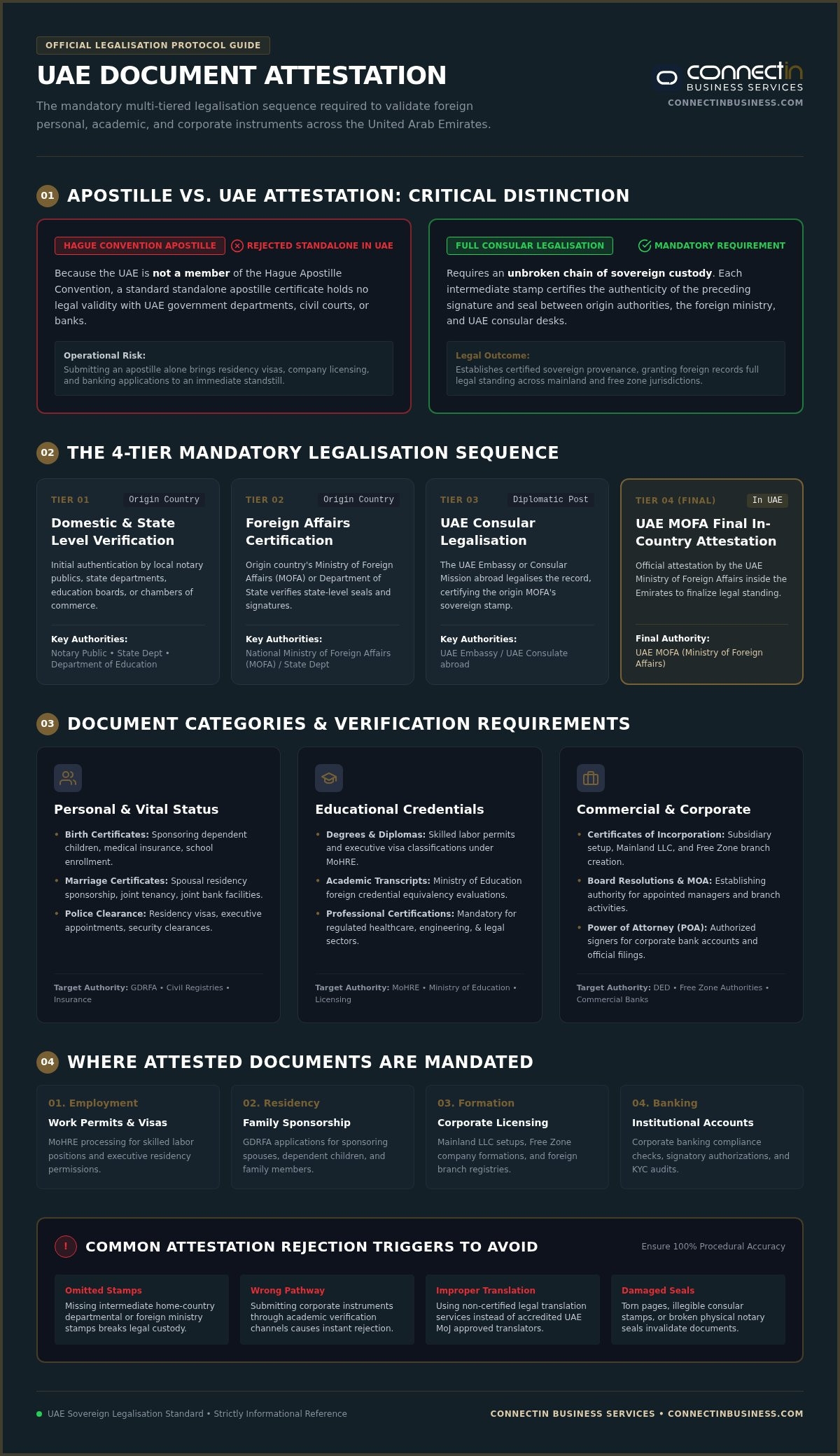
International document cross-recognition hinges on one decisive legal factor: multilateral treaty membership. The 1961 Hague Apostille Convention establishes a streamlined framework allowing public records from one member nation to be recognized in another via a single standardized certificate. However, this mutual recognition applies only when both the issuing state and the receiving state are formal signatories. The United Arab Emirates has not acceded to the Hague Apostille Convention. Consequently, attempting to submit a standalone apostilled certificate directly to Dubai courts, free zones, or federal ministries leads to immediate administrative rejection. Valid document attestation uae authorities will accept requires a complete consular legalisation chain instead.
- Hague Apostille: Standardized single certificate recognized exclusively between approximately 130 member jurisdictions; bypasses embassy involvement.
- UAE Consular Legalisation: Multi-tiered sequential authentication chain ending with Ministry of Foreign Affairs validation; mandatory for all non-signatory jurisdictions.
The Mechanics of the Hague Apostille
An apostille features a standardized ten-field certificate generated by an originating country's designated competent authority, such as a state department or foreign ministry. It verifies signature authenticity, signatory capacity, and identity seals. Between signatory nations, this single certificate eliminates all need for consular intervention or subsequent domestic counter-stamping. Its legal reach ends abruptly at the borders of non-signatory states, meaning an apostille alone possesses zero statutory standing inside the UAE.
The Multi-Tier Consular Legalization Chain
Because the UAE remains outside the convention, foreign instruments must proceed through full diplomatic authentication. This process requires destination consular validation within the country of origin before the paperwork ever arrives in the Emirates. Each governing body in the sequence verifies only the stamp affixed by the official tier immediately preceding it. The complete authentication chain follows an exact legal architecture:
- Origin Verification: Domestic validation by municipal registries, institutional bodies, or state education departments.
- Origin Foreign Ministry Authentication: Sovereign validation confirming the domestic issuing authority's authority.
- UAE Embassy Legalization: Consular endorsement by the UAE diplomatic mission stationed within the issuing nation.
- Inward Territorial Attestation: Final physical or electronic validation executed by the UAE Ministry of Foreign Affairs (MoFA) inside the country.
Overlooking any single link across this chain renders the underlying record legally void for domestic visa processing, corporate incorporation, and banking onboarding across all seven emirates.
Step-by-Step Procedure to Attest Foreign Documents for the UAE
Transforming an overseas certificate into an accepted legal record requires a precise, five-stage protocol. Official portals frequently display only their isolated domestic steps, which misleads applicants regarding the broader international journey. Completing document attestation uae ministries accept demands following an exact sequence across foreign jurisdictions and domestic UAE systems. Altering this operational order creates immediate procedural dead ends.
- Domestic Verification: Authenticate signatures through local record offices, regional educational boards, or commercial chambers.
- Home Foreign Ministry Legalization: Secure federal certification verifying the domestic issuing body's authority.
- UAE Embassy Authentication: Present the instrument to the accredited UAE diplomatic mission located abroad.
- Inward UAE MoFA Attestation: Complete destination authentication via official UAE digital platforms or authorized courier channels.
- Certified Legal Translation: Translate the completed instrument into Arabic through a certified translator accredited by the UAE Ministry of Justice.
Phase 1: Origin Country Legalization Protocols
Everything starts within the country of issuance. Academic qualifications must be authenticated by the originating university registrar or regional higher education commission before advancing. Personal vital certificates require endorsement from municipal civil registries or regional state departments. Commercial records must first pass through local chambers of commerce. Once foundational checks conclude, the national foreign affairs ministry of the home jurisdiction affixes its sovereign authentication seal.
Phase 2: Consular Stamping and Inward UAE MOFA Verification
Once authenticated by the origin government, records proceed to the UAE Embassy or Consular Mission accredited to that nation. Notably, several UAE missions abroad have introduced a consolidated electronic legalisation format that pairs consular verification with the final ministry stamp on a single digital page. Where standard workflows apply, the physical record travels to the Emirates. Users then log in to the official Ministry of Foreign Affairs portal using their UAE Pass to register the dossier. Turnaround times for physical courier verification typically span one to three business days, while eligible domestic digital certificates finalize within hours.
Completing inward attestation is often followed by mandatory language compliance, as official proceedings require documentation in Arabic. Avoid costly procedural delays by choosing to coordinate your document attestation and certified legal translation through seasoned administrative specialists who oversee the entire cross-border trajectory.
Overcoming Attestation Challenges and Ensuring Corporate Compliance
Administrative missteps in foreign jurisdictions quickly snowball into costly setbacks in the Emirates. A single missing preliminary endorsement or flawed translation halts corporate licensing, stalls visa issuance, and suspends banking onboarding. Overcoming these procedural hurdles requires understanding the exact technical compliance standards enforced by mainland departments and free zone authorities.
Common Document Legalization Pitfalls
Physical document defects trigger immediate rejections at consular counters. Laminating original certificates is a frequent mistake. Plastic coating prevents officials from applying physical ink stamps and embossed seals directly to the paper, forcing applicants to order duplicate originals from issuing bodies abroad. Timing and sequence cause equal disruption. Skipping an intermediate regional verification breaks the chain of custody. Additionally, certain instruments carry strict validity windows. While ministerial stamps don't expire, receiving entities often demand that police clearance certificates and corporate records be issued within three to six months of submission.
Certified Legal Translation and Judicial Compliance
Consular endorsements validate an instrument's foreign sovereign trail, but official domestic processing requires local language compliance. UAE federal regulations mandate that non-Arabic records submitted to civil courts, mainland licensing departments, and immigration ministries must include certified legal translation. These translations must be completed by translators accredited by the UAE Ministry of Justice. Accredited translators translate both the core document text and the entire sequence of international attestation seals, ensuring complete evidentiary standing across local bodies.
Accelerating Administrative Approvals with Corporate PRO Services
Aligning cross-border legalisation with local commercial milestones demands synchronized administrative execution. Coordinating document attestation uae protocols alongside trade license amendments, mainland company formation, and employment visa issuance prevents administrative friction and costly operational stalls.
Managing these intersecting governmental requirements is most efficient when handled by seasoned administrative specialists. Many expanding enterprises partner with ConnectIn Business Services to manage corporate PRO workflows, accredited legal translation, and multi-tier document attestation, ensuring fully compliant market entry across the UAE.
Master Your Path to Flawless UAE Document Legalization
Establishing legal standing in the Emirates demands methodical attention to regulatory detail. Successfully completing document attestation uae ministries approve requires completing domestic verifications, foreign consular endorsements, and destination ministry approvals without skipping intermediate stages. Pairing this sequential chain with Ministry of Justice accredited Arabic legal translation guarantees your filings clear regulatory desks without administrative friction.
You don't have to navigate these intricate cross-border channels alone. Whether you're authenticating personal qualifications for residency or preparing foreign corporate instruments for trade license amendments, specialized administrative guidance protects your expansion timelines. Streamline your document attestation and UAE business setup with ConnectIn Business Services to secure end-to-end PRO support, certified translation, and rapid operational readiness across mainland and free zone jurisdictions. Your venture in Dubai is ready to move forward with complete compliance and total peace of mind.
Frequently Asked Questions
Can an apostilled document be used directly in the UAE without consular attestation?
No, an apostille cannot be used directly in the UAE. The country isn't a signatory to the Hague Apostille Convention. Any foreign record bearing only an apostille will be immediately rejected by local ministries, courts, and banks. To achieve valid document attestation uae authorities will accept, you must complete the full consular legalisation chain, concluding with UAE Ministry of Foreign Affairs verification.
Is MOFA attestation mandatory for all foreign documents used in the UAE?
Yes, inward destination attestation by the Ministry of Foreign Affairs is mandatory for every foreign instrument intended for official legal, corporate, or residency use. Even if your records possess authentications from your origin country and the accredited UAE Embassy abroad, they lack territorial legal force until validated by the ministry. Without this final step, government entities in Dubai cannot formally accept the paperwork.
What is the difference between document attestation and notarization?
Notarization verifies the identity of the person signing a document, whereas attestation verifies the authenticity of official seals and signatures across government tiers. Notaries witness signatures locally during initial drafting. Attestation, by contrast, is an international diplomatic sequence carried out by government ministries and foreign embassies. Domestic notary services in Dubai remain strictly within the purview of officially appointed public and private notaries.
How long does a completed UAE document attestation remain legally valid?
The physical or digital ministry attestation stamp itself does not expire once successfully affixed. However, the underlying record may have an administrative validity window defined by the receiving authority. Documents like police clearance certificates, certificates of good standing, and medical fitness records often must be issued within three to six months to be accepted by Dubai immigration departments or mainland commercial licensing authorities.
Can educational degrees be attested without providing original transcripts?
Most educational attestation pipelines require official academic transcripts or a formal verification letter alongside the degree certificate. Origin country education departments and UAE consular missions routinely cross-reference degree certificates against institutional records to verify genuine accreditation. Failing to supply accompanying transcripts or authorized verification letters from the issuing university registrar often results in immediate suspension of your document attestation uae application.
What happens if my original document is laminated before attestation?
Laminated documents are rejected because consular and ministerial officials cannot apply physical ink stamps, stickers, or raised seals onto plastic coatings. Attempting to peel off thermal lamination carries a high risk of tearing the paper or lifting official ink signatures, which invalidates the record entirely. If your certificate is laminated, you must request an official replacement or certified duplicate from the original issuing authority before starting.
Is certified Arabic legal translation required after completing MOFA attestation?
Yes, certified Arabic legal translation is mandatory if the foreign document will be submitted to UAE civil courts, mainland government departments, or federal ministries. While English documentation is frequently accepted within certain free zone registries and private corporate banking settings, public judicial and administrative systems require Arabic text. The translation must be completed by a translator accredited by the UAE Ministry of Justice.


