

With an AED 3.2 billion investment dedicated to its specialized infrastructure, dubai commercity has redefined the regional digital economy by offering a bespoke environment for e-commerce growth. Establishing a presence in the Middle East’s first dedicated e-commerce free zone is a strategic move, but the complexity of the UAE regulatory environment can often feel overwhelming. You've likely identified the potential for 100% foreign ownership, yet remain cautious about the nuances of the 9% corporate tax regime or the administrative burden of document attestation. It's a common challenge for ambitious brands aiming to scale without falling into logistics bottlenecks.
This guide provides a comprehensive roadmap for managing your setup with precision and confidence. You'll discover how to leverage world-class logistics infrastructure and expert-led strategies to ensure a compliant, streamlined entry into the market. We'll examine the specific licensing pathways available in 2026, the critical role of PRO services in managing Ministry of Foreign Affairs requirements, and the structural advantages of the DIEZ governance model. By the end of this article, you'll have a clear, actionable plan to transform your digital vision into a fully operational, tax-efficient reality within the Emirates.
Key Takeaways
- Identify the strategic advantages of the dubai commercity infrastructure to optimize your regional logistics and distribution speed.
- Understand the specific criteria for Qualifying Free Zone Person status to secure a 0% corporate tax rate while maintaining full legal ownership.
- Determine the most appropriate licensing structure for your model, including the operational benefits of dual licensing for direct UAE mainland access.
- Learn how professional PRO services and document attestation streamline the regulatory process to ensure a compliant and efficient business launch.
- Discover how expert-led administrative support eliminates the friction of certified legal translations and complex government liaisons.
What is Dubai Commercity? The First Dedicated E-commerce Hub
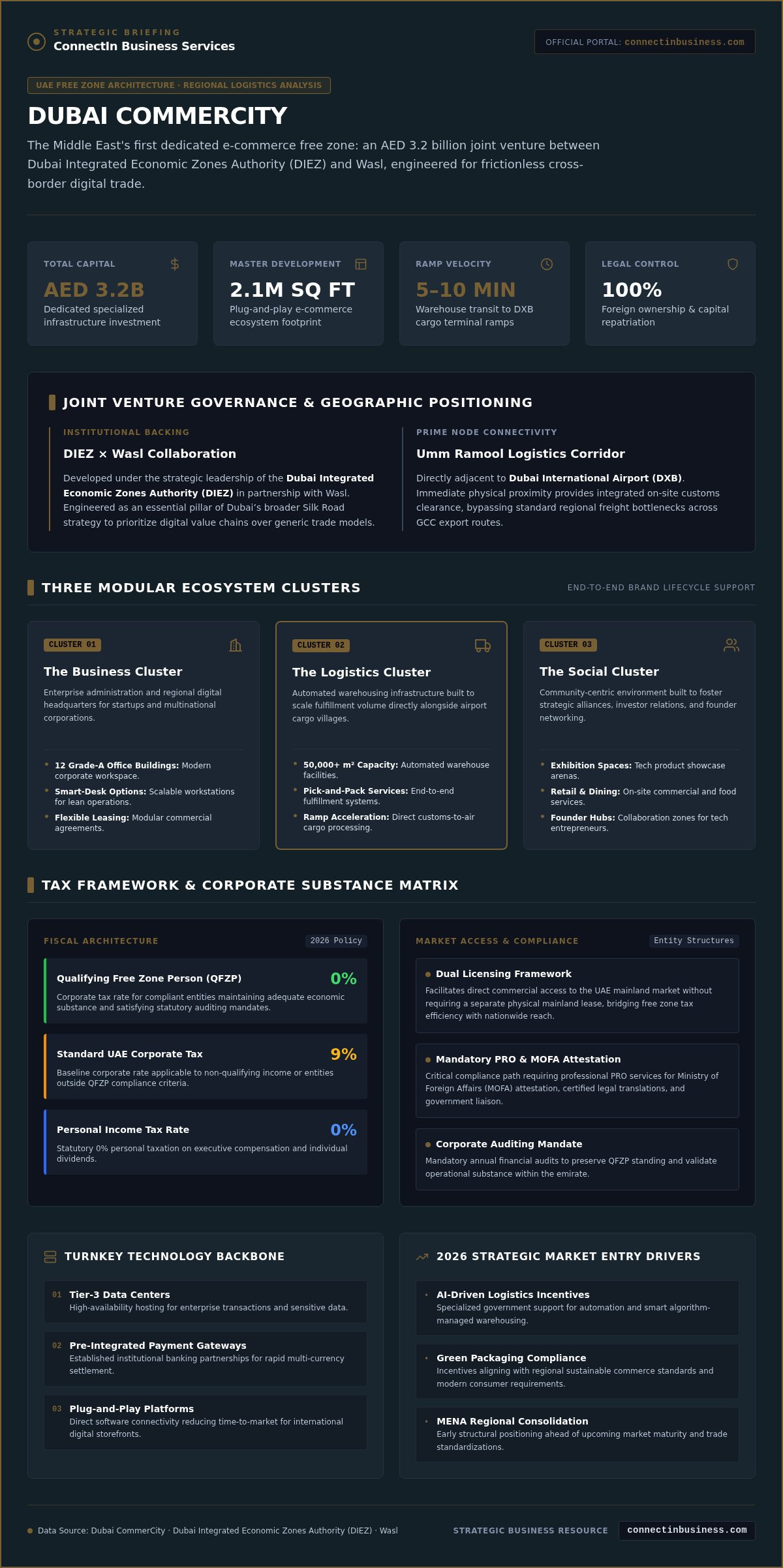
Dubai CommerCity represents a specialized shift in the regional economic strategy. Developed as a joint venture between the Dubai Integrated Economic Zones Authority (DIEZ) and Wasl, it serves as the Middle East’s first free zone dedicated exclusively to the e-commerce sector. This project occupies a prime location in Umm Ramool, positioned directly adjacent to Dubai International Airport (DXB). This proximity to one of the world’s busiest cargo villages ensures that transit times to terminal ramps are reduced to minutes, facilitating rapid regional customs clearance. Within the broader context of free-trade zones in Dubai, this hub stands out by prioritizing the digital value chain over traditional general trading.
The zone’s infrastructure is divided into three distinct clusters designed to support the entire lifecycle of a digital brand:
- The Business Cluster: Includes 12 Grade-A office buildings with flexible leasing and smart-desk options.
- The Logistics Cluster: Features over 50,000 square meters of automated warehousing and pick-and-pack services.
- The Social Cluster: Provides retail, dining, and exhibition spaces to foster networking among tech founders.
This modular design addresses the specific needs of e-commerce merchants, payment providers, and logistics consultants. By integrating these services into a single ecosystem, the authority eliminates many of the friction points common in cross-border trade.
The Vision Behind the 2.1 Million Square Foot Project
The core objective of this 2.1 million square foot development is to lower the barrier to entry for global and regional brands. By providing a "plug-and-play" ecosystem, the zone allows startups and SMEs to bypass the typical friction associated with physical infrastructure. It's a critical component of Dubai’s "Silk Road" strategy, which aims to enhance the emirate's position as a global logistics gateway. This environment doesn't just offer space; it provides an integrated fulfillment model that scales alongside your business volume. It's built to ensure that companies can focus on their core digital strategy rather than administrative bottlenecks.
Why 2026 is the Strategic Year for Entry
Entering the market in 2026 is a calculated move for digital enterprises. While some sectors show signs of maturity, the MENA e-commerce market continues to expand. Establishing your presence within dubai commercity now allows you to leverage new digital trade regulations that prioritize consumer protection and secure transactions. Current incentives focus heavily on sustainable and tech-driven ventures, offering specialized support for companies implementing AI-driven logistics or green packaging solutions. You'll secure a foothold before the next wave of market consolidation. The timing is ideal for brands looking to transition from simple online storefronts to fully integrated logistics powerhouses.
The Strategic Advantages of Setting Up in Dubai Commercity
Operating within dubai commercity offers more than just a legal license; it provides access to a highly specialized ecosystem designed to eliminate the common friction points of digital trade. One of the primary drivers for international investors is the ability to maintain 100% foreign ownership while benefiting from 100% repatriation of capital and profits. While personal income tax remains at 0%, the 2026 corporate tax landscape requires a more nuanced approach. Entities can qualify for a 0% corporate tax rate as a Qualifying Free Zone Person (QFZP), provided they maintain adequate substance and comply with mandatory auditing requirements. This fiscal efficiency is supported by a robust technology infrastructure, including Tier-3 data centers and smart office solutions that allow for immediate operational readiness. Pre-integrated e-commerce platforms and established payment gateway partnerships further accelerate the time-to-market for new ventures.
Logistics and Fulfillment: The Competitive Edge
The Logistics Cluster provides a distinct competitive edge through its physical integration with Dubai International Airport. On-site customs clearance processes accelerate cross-border trade, allowing goods to move from the warehouse to terminal ramps within five to ten minutes. This speed is essential for brands competing on delivery times across the GCC. Additionally, the zone offers shared warehousing models, which significantly reduce overhead costs for startups that don't yet require dedicated facilities. Understanding the commercial distribution and sales channels in the UAE is vital for brands looking to bridge the gap between free zone storage and mainland customers. This is particularly relevant when utilizing the DET Dual License, which permits direct retail to the local market without a separate mainland lease.
The Social Cluster: Networking and Talent
The Social Cluster acts as a catalyst for growth by connecting founders with a specialized talent pool and regional venture capitalists. It isn't merely a space for retail and dining; it’s a dedicated environment where digital professionals can collaborate in purpose-built co-working spaces. Regular networking events provide direct access to tech partners and investors who understand the specific scaling challenges of e-commerce. These interactions often lead to partnerships that go beyond simple service agreements, fostering a community of innovation. For those looking to navigate these complex structural decisions, engaging with ConnectIn Business Services ensures your setup is both compliant and strategically positioned for long-term growth.
Licensing Options and the Company Formation Process
Establishing a presence in dubai commercity requires a precise alignment between your business model and the available license categories. The Dubai CommerCity Authority, operating under the DIEZ umbrella, provides specialized licenses tailored to the digital economy. Most founders opt for the E-commerce license, which permits the direct online trading of goods and services. Alternatively, the Service license supports consultancy and digital marketing, while the General Trading license offers flexibility for multi-commodity operations. You must also decide between forming a Free Zone Limited Liability Company (FZ-LLC) as a standalone entity or registering a Branch of an existing local or foreign parent company. Each structure carries different implications for liability and capital requirements.
The 2026 UAE Corporate Tax regime adds a layer of complexity to this choice. To maintain the 0% tax rate on qualifying income, your entity must demonstrate adequate economic substance and submit certified audited financial statements. This isn't a suggestion; it's a mandatory requirement for any firm seeking Qualifying Free Zone Person status. The authority acts as a facilitator during this process, but the burden of proof regarding operational substance remains with the business owner. Proper planning at the licensing stage ensures you don't inadvertently trigger the standard 9% tax rate on your global revenue.
Step-by-Step Registration Framework
The formation process begins with trade name reservation and initial approval from the authority. You'll need to draft a Memorandum of Association (MOA) that clearly defines your business activities and shareholding structure. For corporate shareholders based outside the UAE, this document requires a comprehensive attestation chain, starting in the country of origin and concluding with the UAE Ministry of Foreign Affairs. Once the MOA is finalized, you'll secure a physical lease within the Business Cluster. This lease is a prerequisite for the issuance of your trade license and serves as your official corporate address for all regulatory filings.
Regulatory Compliance and VAT for E-commerce
Compliance extends beyond the initial setup. UAE VAT regulations apply a standard 5% rate on supplies made within the country, while exports to markets outside the GCC are generally zero-rated. If your annual taxable supplies exceed AED 375,000, mandatory registration with the Federal Tax Authority is required. Additionally, e-commerce entities must adhere to Economic Substance Regulations (ESR) by performing relevant core income-generating activities within the zone. Maintaining meticulous records is essential. The authority requires all free zone entities to keep books of account for at least five years, ensuring you're prepared for any potential audit. Proper record-keeping protects your status as a tax-efficient entity in a demanding environment.
Critical Administrative Requirements: PRO and Attestation
While the specialized infrastructure of dubai commercity simplifies digital operations, the administrative path to full compliance remains rigorous. Success in the UAE market requires more than just a digital storefront; it demands a meticulous approach to government liaison and document legalization. Every corporate document, from board resolutions to certificates of incorporation, must be verified through a specific chain of authority. This process ensures that your entity is recognized as a legitimate legal person within the Emirates. Neglecting these steps can lead to significant delays in bank account activation or visa issuance, stalling your time-to-market.
Managing these requirements involves navigating multiple departments, including the Ministry of Foreign Affairs (MOFA) and the General Directorate of Residency and Foreigners Affairs (GDRFA). The complexity of these interactions often necessitates expert intervention to avoid common pitfalls. For businesses aiming to scale, maintaining a clean administrative record is as important as their sales strategy. This is where dedicated PRO support becomes an essential operational asset.
Document Attestation and Legal Translation
Foreign educational and corporate documents require multi-stage attestation because the UAE government must verify the authenticity of the issuing authority abroad. This involves notarization in the home country, followed by embassy legalization and final electronic attestation by the UAE MOFA. Once attested, these documents must undergo certified legal translation into Arabic. This ensures that government officials and judicial bodies can accurately interpret your corporate structure and authorities. Professional PRO services act as the primary facilitator for managing trade license amendments and share transfers by ensuring all changes are reflected across government portals without operational delays. Accurate translation prevents the legal ambiguities that could otherwise complicate future trade license renewals or share transfers.
Visa Processing and Corporate Bank Account Opening
Securing residency is a multi-step process that begins immediately after the trade license is issued. Founders and investors may be eligible for the UAE Golden Visa if their investment in dubai commercity meets the current long-term residency criteria. For standard employment visas, the timeline typically spans two to three weeks, encompassing the medical fitness test, Emirates ID biometrics, and electronic visa issuance. Corporate bank account opening remains a notable challenge for e-commerce firms due to strict Anti-Money Laundering (AML) and Know Your Customer (KYC) protocols. Banks often view digital trading as a high-risk sector, requiring comprehensive business plans and proof of physical substance. Preparing these documents in advance, with the help of a seasoned guide, significantly improves your chances of a successful application. To ensure your administrative foundation is secure, you can access comprehensive PRO and attestation support to manage these critical milestones on your behalf.
How ConnectIn Business Services Facilitates Your Commercity Setup
ConnectIn Business Services operates as a specialized facilitator for founders entering the Middle East’s digital economy. Establishing a presence in dubai commercity requires more than a simple application; it demands a strategic alignment of your corporate structure with UAE federal laws. We provide end-to-end management of the company formation lifecycle, ensuring that every administrative milestone is met with precision. From the initial trade name reservation to the final issuance of the trade license, our team handles the technical complexities so you can focus on operational growth.
Our role extends beyond the initial setup phase. As your business scales, you may require trade license amendments or share transfer services to accommodate new investors or shifting market strategies. We manage these transitions seamlessly, coordinating with the relevant free zone authorities to update your legal status without disrupting your daily operations. This proactive approach ensures that your entity remains in good standing with both the DIEZ governance and the Federal Tax Authority. By acting as your dedicated representative, we eliminate the friction typically associated with navigating a foreign regulatory landscape.
Our Strategic Approach to Business Setup
We begin with a detailed consultation to align your specific e-commerce model with the most advantageous license type. This early-stage planning is critical for ensuring that your activities are correctly categorized to benefit from the 0% corporate tax regime. We maintain direct coordination with the Dubai CommerCity authorities to expedite approvals and resolve any regulatory queries in real time. Our team manages the entire document attestation chain, ensuring that your corporate papers are legally recognized within the Emirates. Should your business needs change, we also provide professional support for company liquidation or restructuring, ensuring that all legal obligations are settled according to UAE standards.
Why Expertise Matters in the Dubai Regulatory Landscape
In a demanding regulatory environment, even minor administrative errors can lead to significant delays or financial penalties. Our deep understanding of the local landscape allows us to navigate the Ministry of Foreign Affairs attestation process and certified legal translation requirements with ease. We leverage our local knowledge to help you secure the most appropriate office and warehouse configurations within the logistics cluster, optimizing your physical footprint for maximum efficiency. Our bespoke PRO solutions handle all government-related interactions, providing you with a single point of contact for your administrative needs. You can contact ConnectIn Business Services for a personalized Commercity roadmap that ensures your entry into the UAE market is both compliant and strategically sound.
Securing Your Competitive Advantage in the Digital Economy
Establishing a presence within dubai commercity offers a sophisticated ecosystem that transforms e-commerce operations through specialized clusters and strategic proximity to global logistics hubs. Succeeding in this environment requires a deep understanding of the 2026 corporate tax landscape and the meticulous execution of administrative requirements. By aligning your business model with the correct licensing structure and ensuring robust document attestation, you position your brand for sustainable growth within the Emirates. Navigating these intricate systems alone can lead to operational delays; however, a structured approach ensures full compliance and long-term security.
ConnectIn Business Services acts as your authoritative guide, offering the expertise needed to bridge the gap between your vision and the UAE’s regulatory standards. Our team provides specialized support in mainland and free zone formation, alongside certified legal translation and comprehensive PRO services. We handle the technical complexities of your setup so you can focus on scaling your digital enterprise. Start your Dubai Commercity journey with ConnectIn Business Services today. Your expansion into the Middle East’s premier e-commerce hub is within reach with the right professional partner by your side.
Frequently Asked Questions
What is the minimum capital requirement for Dubai Commercity setup?
The minimum share capital for a dubai commercity setup is generally not fixed at a high threshold, but it must be sufficient to support the company’s intended operations. For a Free Zone Limited Liability Company (FZ-LLC), the capital is divided into shares, typically with a value of AED 1,000 each. While the authority is flexible, specific activities might require higher capitalization to satisfy regulatory or banking compliance standards during the formation process.
Can I sell products directly to the UAE mainland from Dubai Commercity?
Free zone entities can sell directly to the UAE mainland by utilizing the DET Dual License, which permits onshore trading without a separate mainland office. Without this specific permit, a business must engage a licensed local distributor or a third-party courier to facilitate the distribution of goods. This structural flexibility allows brands to reach local consumers while maintaining the benefits of a specialized e-commerce hub and integrated logistics clusters.
How long does it take to get an e-commerce license in Dubai Commercity?
The timeline for securing an e-commerce license typically ranges from five to ten working days, provided all documentation is complete and properly attested. This period covers trade name reservation, initial approval, and the final issuance of the digital license. Complex corporate structures involving foreign shareholders may experience longer processing times due to the multi-stage attestation requirements for corporate papers and the time needed for Ministry of Foreign Affairs verification.
Do I need a physical office to register a company in Dubai Commercity?
A physical presence is mandatory for company registration, although the authority offers flexible solutions like smart desks and serviced offices. These options fulfill the legal requirement for a registered address while minimizing initial overhead for startups. As your business scales, you can transition to larger, dedicated office spaces or shell-and-core units within the Business Cluster to accommodate growing staff levels and satisfy more rigorous economic substance requirements.
What are the customs duties for businesses operating in Commercity?
Businesses benefit from 0% customs duties on goods imported into the free zone for storage, assembly, or re-export to international markets. However, if products are moved from the logistics cluster into the UAE mainland for local consumption, a standard 5% customs duty generally applies. This tax-efficient structure is ideal for regional distribution hubs that prioritize cross-border trade while serving the local market through authorized and compliant distribution channels.
How does Dubai Commercity support last-mile delivery?
The hub supports last-mile delivery through strategic partnerships with tier-1 logistics providers who offer end-to-end fulfillment services. These partners manage the entire process, from automated warehousing and robotic sorting to final delivery at the customer’s doorstep. By utilizing these pre-integrated systems, tenants can reduce delivery times and improve the overall customer experience without investing in their own fleet or complex logistics technology, keeping operations lean and efficient.
Can I switch my existing Dubai license to Dubai Commercity?
It's possible to migrate an existing business to this zone, though the process depends on the current jurisdiction of your trade license. You may choose to establish a new branch or undergo a formal transfer of incorporation if your current authority permits it. For many, a more efficient route involves the liquidation of the old entity followed by a fresh setup in the specialized dubai commercity environment to access tailored e-commerce incentives.
What PRO services are essential for a new e-commerce business?
Essential PRO services for a new digital venture include document attestation for foreign papers and certified legal translation for government submissions. Beyond the initial setup, you'll need ongoing support for visa processing, Emirates ID applications, and trade license renewals. Specialized assistance with trade license amendments and share transfers is also vital as the company grows, ensuring that all corporate changes remain compliant with the evolving UAE regulatory and tax environment.


